pacman::p_load(tmap, sf, sp, reshape2, ggplot2, ggpubr, tidyverse, stplanr, knitr, kableExtra, spdep)

devtools::install_github("LukeCe/spflow")
library(spflow)Take-home Exercise 3 (Revised): Exploratory Spatial Data Analysis for Potential Push & Pull Factors of Locations in Singapore using Public Bus Data
1.0 Overview
In this exercise, my focus would be on prototyping exploratory spatial data analysis, particularly density of spatial assets within hexagonal traffic analysis zones. In conventional geography, a traffic analysis zone is the unit most commonly used in transportation planning models and the size of it varies. Hexagonal traffic analysis zones has gained traction as the hexagons of the study area have a uniform size which are easily comparable with each other when determining transport attractiveness. It is also recommended that hexagon radius should be 125m for areas in high urbanisation and 250m in areas with less urbanisation (Chmielewski et al., 2020).
The data preparation for this purpose also supports the preparation for calibrating spatial interaction models. For the prototyping, only exploratory spatial data analysis will be done.
2.0 Package Installation
I will load up the below R packages for the following purposes:
tmap: to visualise spatial data by creating thematic maps that could be interactive or static.
sf: to manipulate spatial data.
sp: to manipulate spatial data (older than sp).
reshape2: to reshape and transform data frames; converting data between “wide” and “long” formats using functions like melt().
ggplot2: to visualise data with plot types including bar plots.
tidyverse: to clean and transform data and contains sub-packagess including tidyr, dplyr and readr.
stplanr: to provide functions suitable for working with spatial transport data like networks, orgins-destinations matrices and travel time matrices; builds on the capabilities of sf and sp packages.
knitr: to combine code into a single documents that can be easily converted to various output formats like html, pdf, or Word.
kableExtra: to further style any Kables.
spdep: to create spatial wieght matrix objects from contiguities
spflow: to estimate spatial econometric interaction models
3.0 Data sources
URA’s Masterplan Subzone 2019 Layer in shapefile format
Bus Stop Locations extracted from LTA
A tabulated bus passenger flow for Nov 2023, Dec 2023 and Jan 2024 from LTA dynamic data mall
Population Data for 2023 from SingStat
Schools from MOE
Financial Services
Hospitals, polyclinics and CHAS clinics derived from Google Maps
4.0 Data preparation
4.1 Data preparation for bus-induced hexagons
Read the subzone layer
mpsz <- st_read("data/geospatial/master-plan-2019-subzone-boundary-no-sea-kml.kml")Convert mpsz to 2D geometry.
mpsz <- st_zm(mpsz, drop = TRUE) # Convert 3D geometries to 2DExtract the SUBZONE_N and PLN_AREA_N from the Dscrptn field
For SUBZONE_N,
mpsz <- mpsz %>%
  rowwise() %>%
  mutate(SUBZONE_N = str_extract(Description, "<th>SUBZONE_N</th> <td>(.*?)</td>")) %>%
  ungroup()

mpsz$SUBZONE_N <- str_remove_all(mpsz$SUBZONE_N, "<.*?>|SUBZONE_N")
For PLN_AREA_N,
mpsz <- mpsz %>%
  rowwise() %>%
  mutate(PLN_AREA_N = str_extract(Description, "<th>PLN_AREA_N</th> <td>(.*?)</td>")) %>%
  ungroup()

mpsz$PLN_AREA_N <- str_remove_all(mpsz$PLN_AREA_N, "<.*?>|PLN_AREA_N")
Remove the Description column.
mpsz$Description <- NULLRemove unwanted outer islands.
mpsz3414 <- mpsz %>% st_transform(crs = 3414)

outer_islands <- c("SEMAKAU", "SUDONG", "NORTH-EASTERN ISLANDS", "SOUTHERN GROUP")
mpsz3414 <- mpsz3414 %>%
  filter(!str_trim(SUBZONE_N) %in% str_trim(outer_islands))
Create the shapefile.
st_write(mpsz3414, "data/geospatial/mpsz3414.shp", append=FALSE)Read the updated shapefile.
mpsz3414 <- st_read("data/geospatial/mpsz3414.shp") Reading layer `mpsz3414' from data source
`C:\guacodemoleh\IS415-GAA\Take-home_Ex\Take-home_Ex03\data\geospatial\mpsz3414.shp'
using driver `ESRI Shapefile'
Simple feature collection with 328 features and 3 fields
Geometry type: MULTIPOLYGON
Dimension: XY
Bounding box: xmin: 2667.538 ymin: 21448.47 xmax: 55941.94 ymax: 50256.33
Projected CRS: SVY21 / Singapore TMRead the aspatial bus stop layer and set its CRS to 3414.
BusStop <- read.csv("data/aspatial/bus_coords_subzone_v2.csv") %>% st_as_sf(coords=c("Longitude", "Latitude"), crs=4326) %>%
  st_transform(crs=3414)

summary(BusStop)
BusStopCode RoadName Description Subzone
Min. : 1012 Length:5107 Length:5107 Length:5107
1st Qu.:25345 Class :character Class :character Class :character
Median :49031 Mode :character Mode :character Mode :character
Mean :48663
3rd Qu.:67065
Max. :99189
geometry
POINT :5107
epsg:3414 : 0
+proj=tmer...: 0
Ensure that all bus stops are within Singapore’s boundary.
BusStop <- BusStop %>% st_intersection(mpsz3414) %>% select(BusStopCode, )

tm_shape(mpsz3414) +
  tm_polygons() +
  tm_shape(BusStop) +
  tm_dots()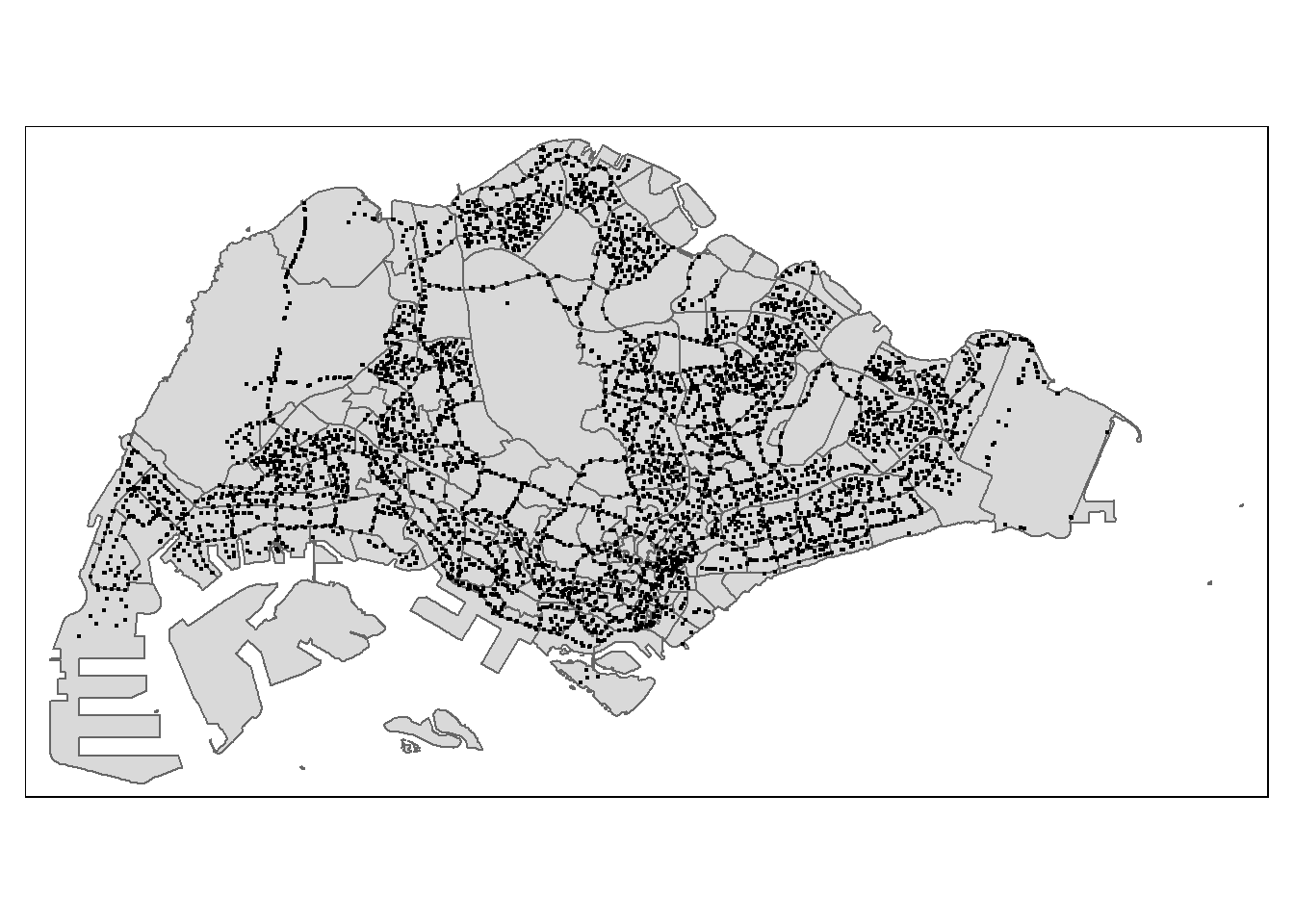
Generate the hexagon grids using st_make_grid() with a cellsize of 750m.
hex_grids <- BusStop %>% st_make_grid(cellsize =750,
                                       what = "polygons",
                                       square = FALSE) %>%
  st_sf() %>%
  filter(lengths(st_intersects(geometry, BusStop)) > 0)
Code interpretation
st_make_grid: creates grids covering areas also without bus stops
cellsize: hexagon size determined by twice the length of the apothem
st_sf: set the hexagons as a sf object
filter: filtering for hexagons that contain bus stops
Have a look and check if the hexagons cover all the bus stop locations.
tm_shape(mpsz3414) +
  tm_polygons(title = "Singapore Boundary") +
  tm_shape(hex_grids) +
  tm_polygons(col = "white", title = "Hexagons", alpha = 1) +
  tm_layout(main.title = "Hexagons corresponding to Singapore bus stops",
            main.title.position = "center",
            main.title.size = 1.0,
            legend.height = 0.35,
            legend.width = 0.35,
            frame = TRUE) +
  tm_compass(type="8star", size = 2, bg.color = "white", bg.alpha = 0.5) +
  tm_scale_bar(bg.color = "white", bg.alpha = 0.5) +
  tm_shape(BusStop) +
  tm_dots(col = "red", size = 0.001, title = "Bus Stops") +
  tm_grid(alpha = 0.2)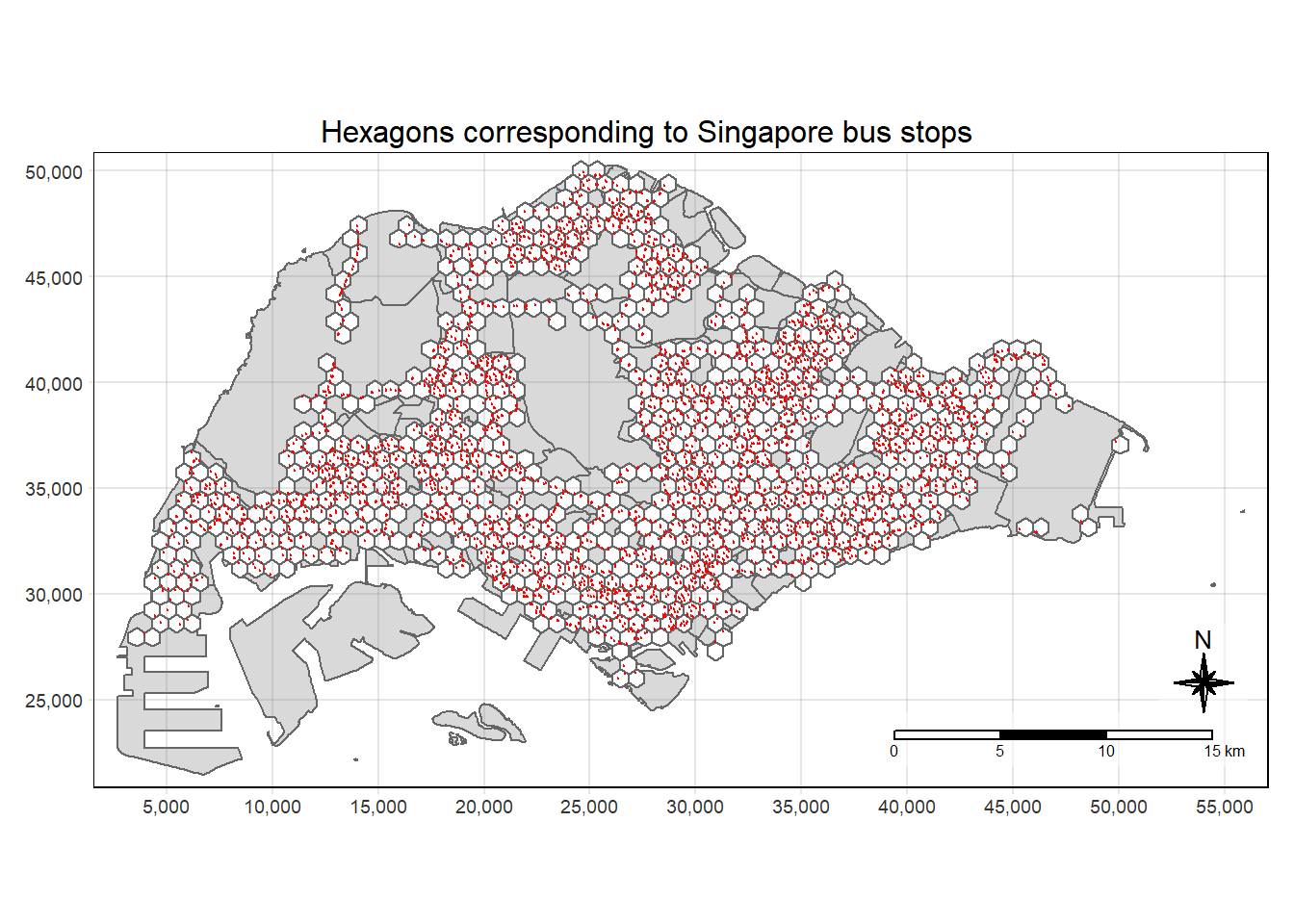
Assign ID to each hexagon
Each hexagon will have an assigned ID that will be their unique identifier. This new information can be stored under the HEX_ID column which will be helpful for joining data frames.
hex_grids$HEX_ID <- sprintf("H%04d", seq_len(nrow(hex_grids))) %>%
  as.factor()
Save the layer
write_rds(hex_grids, "data/rds/hex_grids.rds")hex_grids <- read_rds("data/rds/hex_grids.rds")
kable(head(hex_grids))| geometry | HEX_ID |
|---|---|
| POLYGON ((3578.167 27517.51… | H0001 |
| POLYGON ((4328.167 27517.51… | H0002 |
| POLYGON ((4328.167 28816.55… | H0003 |
| POLYGON ((4328.167 30115.59… | H0004 |
| POLYGON ((4703.167 28167.03… | H0005 |
| POLYGON ((4703.167 29466.07… | H0006 |
4.2 Spatial Interaction Analysis
Combining OD data
od_bus_nov <- read_csv("data/OD Bus/merged_bus_nov_v2.csv")
od_bus_dec <- read_csv("data/OD Bus/merged_bus_dec_v2.csv")
od_bus_jan <- read_csv("data/OD Bus/merged_bus_jan_v2.csv")
OD <- rbind(od_bus_nov, od_bus_dec)
OD <- rbind(OD, od_bus_jan)
nrow(od_bus_nov) + nrow(od_bus_dec) + nrow(od_bus_jan) == nrow(OD) # evaluates to TRUEstr(OD)ORIGIN_PT_CODE and DESTINATION_PT_CODE are listed as character variables. These variables should be transformed to factors so that R treats them as grouping variables.
cols_to_convert <- c("ORIGIN_PT_CODE", "DESTINATION_PT_CODE")

OD[cols_to_convert] <- lapply(OD[cols_to_convert], as.factor)

glimpse(OD)ORIGIN_PT_CODEandDESTINATION_PT_CODE` are now factors.
write_rds(OD, "data/rds/odbus_combined.rds")odbus_combined <- read_rds("data/rds/odbus_combined.rds")
Creating Commute Flow Data
od <- odbus_combined %>%
  group_by(ORIGIN_PT_CODE, ORIGIN_SUBZONE, DESTINATION_PT_CODE, DESTINATION_SUBZONE, DAY_TYPE ,TIME_PER_HOUR) %>%
  summarise(TRIPS = sum(TOTAL_TRIPS)) %>%
  ungroup()

write_rds(od, "data/rds/od.rds")
od <- read_rds("data/rds/od.rds")
Generating O-D trip data by hexagon level
We can create a lookup table for the bus stops associated to each hexagon.
Generating lookup table for bus stop to associated hexagon
To connect the trip data to their corresponding hexagons, a lookup table needs to be made so that there is a relationship beetween the aspatial od and hex_grids.
bs_hex <- st_intersection(BusStop, hex_grids) %>%
  st_drop_geometry() %>%
  select(c(BusStopCode, HEX_ID))

kable(head(bs_hex))| BusStopCode | HEX_ID | |
|---|---|---|
| 1241 | 25059 | H0001 |
| 1241.1 | 25059 | H0002 |
| 1341 | 25751 | H0003 |
| 1395 | 26379 | H0004 |
| 1342 | 25761 | H0005 |
| 1337 | 25711 | H0006 |
Multiple HEX_ID per bus stop
Some bus stops may fall in the boundary of neighbouring hexagons. To resolve this, such bus stops shall be assigned to the first identified corresponding HEX_ID.
bs_hex <- bs_hex %>%
  group_by(BusStopCode) %>%
  summarise(across(everything(), first)) %>%
  ungroup()

nrow(bs_hex) == nrow(BusStop)
[1] TRUE
Joining od and bs_hex
Associate the origin bus stops and destination bus stops to their corresponding hexagons.
bs_hex$BusStopCode <- as.factor(bs_hex$BusStopCode)

od_trips_w_hex <- od %>%
  inner_join(bs_hex,
             by = c("ORIGIN_PT_CODE" = "BusStopCode")) %>%
  rename(ORIG_HEX_ID = HEX_ID) %>%
  inner_join(bs_hex,
             by = c("DESTINATION_PT_CODE" = "BusStopCode")) %>%
  rename(DEST_HEX_ID = HEX_ID)

kable(head(od_trips_w_hex))| ORIGIN_PT_CODE | ORIGIN_SUBZONE | DESTINATION_PT_CODE | DESTINATION_SUBZONE | DAY_TYPE | TIME_PER_HOUR | TRIPS | ORIG_HEX_ID | DEST_HEX_ID |
|---|---|---|---|---|---|---|---|---|
| 10009 | BUKIT MERAH | 10017 | BUKIT MERAH | WEEKDAY | 5 | 9 | H0381 | H0455 |
| 10009 | BUKIT MERAH | 10017 | BUKIT MERAH | WEEKDAY | 7 | 5 | H0381 | H0455 |
| 10009 | BUKIT MERAH | 10017 | BUKIT MERAH | WEEKDAY | 8 | 2 | H0381 | H0455 |
| 10009 | BUKIT MERAH | 10017 | BUKIT MERAH | WEEKDAY | 9 | 29 | H0381 | H0455 |
| 10009 | BUKIT MERAH | 10017 | BUKIT MERAH | WEEKDAY | 10 | 11 | H0381 | H0455 |
| 10009 | BUKIT MERAH | 10017 | BUKIT MERAH | WEEKDAY | 11 | 14 | H0381 | H0455 |
::: {,callout-warning collapse=“true”} ### Save Data Memory Space
od is not needed anymore since the necessary data has been extracted, so we can offload it.
rm(od)
Aggregating data by hexagon
Perform aggregations by ORIGIN_HEX_ID and DEST_HEX_ID to have an aggregated sum of trips by hexagon instead of bus stops.
od_hex <- od_trips_w_hex %>%
  group_by(ORIG_HEX_ID, ORIGIN_SUBZONE ,DEST_HEX_ID, DESTINATION_SUBZONE, DAY_TYPE, TIME_PER_HOUR) %>%
  summarise(TRIPS = sum(TRIPS))

kable(head(od_hex))| ORIG_HEX_ID | ORIGIN_SUBZONE | DEST_HEX_ID | DESTINATION_SUBZONE | DAY_TYPE | TIME_PER_HOUR | TRIPS |
|---|---|---|---|---|---|---|
| H0001 | TUAS | H0005 | TUAS | WEEKDAY | 18 | 2 |
| H0001 | TUAS | H0006 | TUAS | WEEKDAY | 7 | 2 |
| H0001 | TUAS | H0006 | TUAS | WEEKDAY | 8 | 9 |
| H0001 | TUAS | H0006 | TUAS | WEEKDAY | 12 | 1 |
| H0001 | TUAS | H0006 | TUAS | WEEKDAY | 16 | 1 |
| H0001 | TUAS | H0006 | TUAS | WEEKDAY | 17 | 1 |
Save the layer
write_rds(bs_hex, "data/rds/bs_hex.rds")
write_rds(od_hex, "data/rds/od_hex.rds")
Generating flow lines
od_hex <- od_hex[, c(1, 3, 2, 4:ncol(od_hex))]

flowlines <- od_hex %>% od2line(
  hex_grids,
  zone_code = "HEX_ID")

write_rds(flowlines, "data/rds/flowlines.rds")
Learning Point
The flow data in the od2line function must have the origin and destination indexes in its first two columns.
flowlines <- read_rds("data/rds/flowlines.rds")Inspect flowlines
Large data size
The flowlines data is very large.
For all visualisations, the number of trips per flowline shown will be 3000 and above.
tm_shape(mpsz3414) +
  tm_polygons(title = "Singapore Boundary", alpha = 0.5) +

  tm_shape(hex_grids) +
  tm_polygons(col = "white", title = "Hexagons", alpha = 1) +

  tm_shape(flowlines[flowlines$TRIPS >= 3000,]) +
  tm_lines(lwd = "TRIPS",
           style = "quantile",
           col = "red",
           scale = c(0.1, 1, 3, 5, 7),
           title.lwd = "# of bus trips",
           alpha = 0.8) +

  tm_layout(main.title = "Overall Bus Passenger Flow for Weekdays)",
            main.title.position = "center",
            main.title.size = 1.0,
            legend.height = 0.35,
            legend.width = 0.35,
            frame = TRUE) +

  tm_compass(type="8star", size = 2, bg.color = "white", bg.alpha = 0.5) +
  tm_scale_bar(bg.color = "white", bg.alpha = 0.5) +
  tm_grid(alpha = 0.2)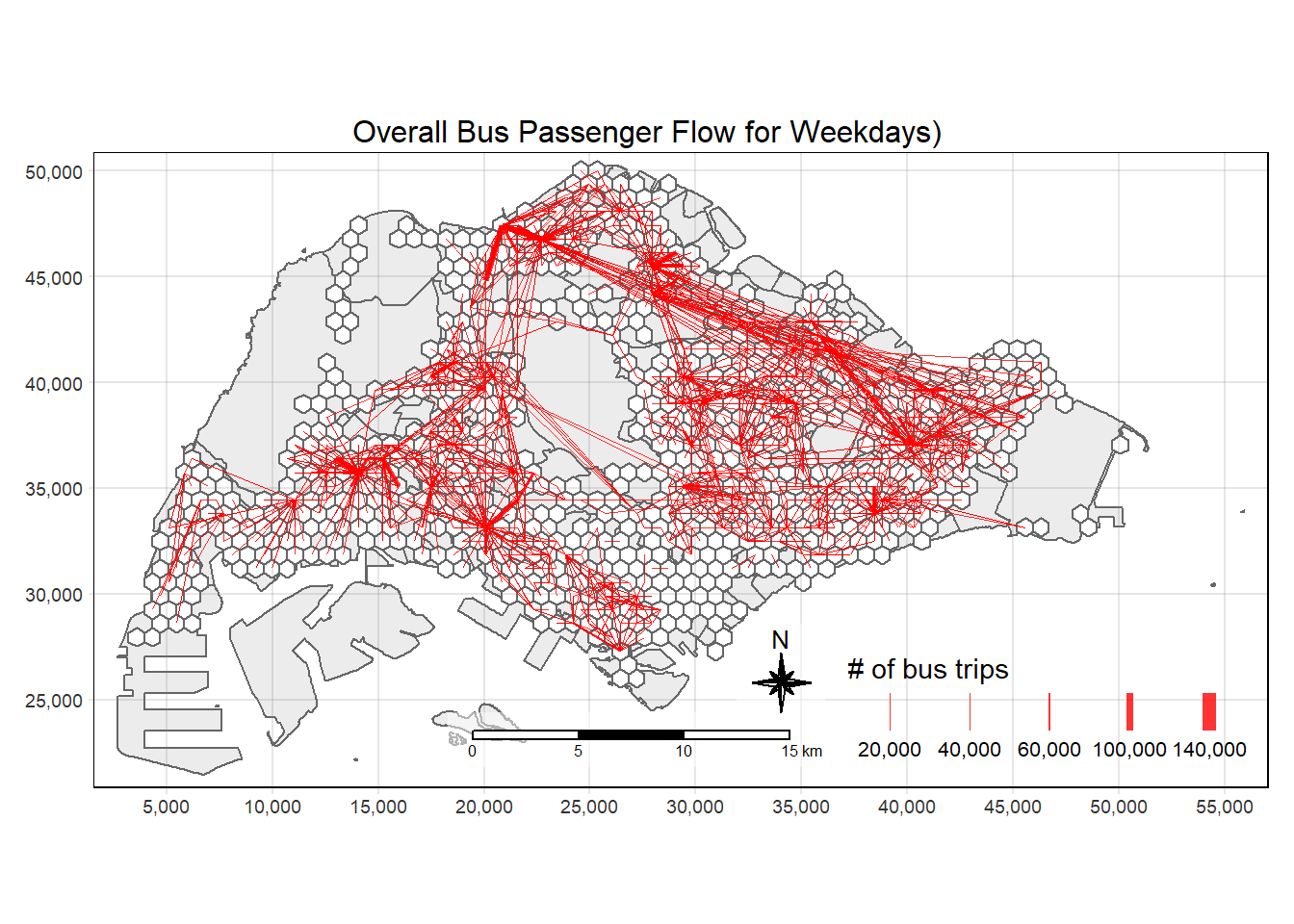
Save Data Memory
rm(flowlines)
rm(od_hex)
4.2.1 Prototype for Spatial Interaction Analysis
5.0 Spatial Interaction Modelling
5.1.1 Attractiveness variables
Initiate the attractiveness from hex_grids.
attractiveness <- hex_grids %>% st_set_crs(3414)For all the variables, we only need to count the number of each location types per hexagon, which can be done using lengths() and st_intersects().
POIs
attractiveness$BUS_STOP_COUNT <- lengths(
  st_intersects(attractiveness, BusStop))
entertn <- st_read("data/geospatial/entertn.shp") %>% st_set_crs(3414)Reading layer `entertn' from data source
`C:\guacodemoleh\IS415-GAA\Take-home_Ex\Take-home_Ex03\data\geospatial\entertn.shp'
using driver `ESRI Shapefile'
Simple feature collection with 114 features and 3 fields
Geometry type: POINT
Dimension: XY
Bounding box: xmin: 10809.34 ymin: 26528.63 xmax: 41600.62 ymax: 46375.77
Projected CRS: SVY21 / Singapore TMattractiveness$ENTERTN_COUNT <- lengths(st_intersects(attractiveness, entertn))food_bev <- st_read("data/geospatial/F&B.shp") %>% st_set_crs(3414)Reading layer `F&B' from data source
`C:\guacodemoleh\IS415-GAA\Take-home_Ex\Take-home_Ex03\data\geospatial\F&B.shp'
using driver `ESRI Shapefile'
Simple feature collection with 1919 features and 3 fields
Geometry type: POINT
Dimension: XY
Bounding box: xmin: 6010.495 ymin: 25343.27 xmax: 45462.43 ymax: 48796.21
Projected CRS: SVY21 / Singapore TMattractiveness$FOOD_BEV_COUNT <- lengths(st_intersects(attractiveness, food_bev))leis_rec <- st_read("data/geospatial/Liesure&Recreation.shp") %>% st_set_crs(3414)Reading layer `Liesure&Recreation' from data source
`C:\guacodemoleh\IS415-GAA\Take-home_Ex\Take-home_Ex03\data\geospatial\Liesure&Recreation.shp'
using driver `ESRI Shapefile'
Simple feature collection with 1217 features and 30 fields
Geometry type: POINT
Dimension: XY
Bounding box: xmin: 6010.495 ymin: 25134.28 xmax: 48439.77 ymax: 50078.88
Projected CRS: SVY21 / Singapore TMattractiveness$LEISURE_COUNT <- lengths(st_intersects(attractiveness, leis_rec))retail <- st_read("data/geospatial/Retails.shp") %>% st_set_crs(3414)Reading layer `Retails' from data source
`C:\guacodemoleh\IS415-GAA\Take-home_Ex\Take-home_Ex03\data\geospatial\Retails.shp'
using driver `ESRI Shapefile'
Simple feature collection with 37635 features and 3 fields
Geometry type: POINT
Dimension: XY
Bounding box: xmin: 4737.982 ymin: 25171.88 xmax: 48265.04 ymax: 50135.28
Projected CRS: SVY21 / Singapore TMattractiveness$RETAIL_COUNT <- lengths(st_intersects(attractiveness, retail))biz <- st_read("data/geospatial/Business.shp") %>% st_set_crs(3414)Reading layer `Business' from data source
`C:\guacodemoleh\IS415-GAA\Take-home_Ex\Take-home_Ex03\data\geospatial\Business.shp'
using driver `ESRI Shapefile'
Simple feature collection with 6550 features and 3 fields
Geometry type: POINT
Dimension: XY
Bounding box: xmin: 3669.148 ymin: 25408.41 xmax: 47034.83 ymax: 50148.54
Projected CRS: SVY21 / Singapore TMattractiveness$BIZ_COUNT <- lengths(st_intersects(attractiveness, biz))fin <- st_read("data/geospatial/FinServ.shp") %>% st_set_crs(3414)Reading layer `FinServ' from data source
`C:\guacodemoleh\IS415-GAA\Take-home_Ex\Take-home_Ex03\data\geospatial\FinServ.shp'
using driver `ESRI Shapefile'
Simple feature collection with 3320 features and 3 fields
Geometry type: POINT
Dimension: XY
Bounding box: xmin: 4881.527 ymin: 25171.88 xmax: 46526.16 ymax: 49338.02
Projected CRS: SVY21 / Singapore TMattractiveness$FIN_COUNT <- lengths(st_intersects(attractiveness, fin))
Data preparation
hdb <- read_csv("data/aspatial/hdb.csv")For the purpose of computing a proxy for population density, the residential units will be extracted using filter() from the dplyr package.
hdb_residential <- hdb %>%
  filter(residential == "Y")

head(hdb_residential, 10)
# A tibble: 10 × 37
...1 blk_no street max_floor_lvl year_completed residential commercial
<dbl> <chr> <chr> <dbl> <dbl> <chr> <chr>
1 0 1 BEACH RD 16 1970 Y Y
2 1 1 BEDOK STH A… 14 1975 Y N
3 3 1 CHAI CHEE RD 15 1982 Y N
4 4 1 CHANGI VILL… 4 1975 Y Y
5 5 1 DELTA AVE 25 1982 Y N
6 6 1 DOVER RD 12 1975 Y N
7 7 1 EUNOS CRES 14 1977 Y N
8 8 1 EVERTON PK 12 1980 Y Y
9 10 1 GHIM MOH RD 15 1975 Y N
10 11 1 HAIG RD 15 1976 Y N
# ℹ 30 more variables: market_hawker <chr>, miscellaneous <chr>,
# multistorey_carpark <chr>, precinct_pavilion <chr>,
# bldg_contract_town <chr>, total_dwelling_units <dbl>, `1room_sold` <dbl>,
# `2room_sold` <dbl>, `3room_sold` <dbl>, `4room_sold` <dbl>,
# `5room_sold` <dbl>, exec_sold <dbl>, multigen_sold <dbl>,
# studio_apartment_sold <dbl>, `1room_rental` <dbl>, `2room_rental` <dbl>,
# `3room_rental` <dbl>, other_room_rental <dbl>, lat <dbl>, lng <dbl>, …There are also some outliers like hotels that are classified as a residential unit. We can remove rows containing ‘hotel’ using grepl().
hotels <- hdb_residential %>%
  filter(grepl("HOTEL", building, ignore.case = TRUE))

kable(hotels)| …1 | blk_no | street | max_floor_lvl | year_completed | residential | commercial | market_hawker | miscellaneous | multistorey_carpark | precinct_pavilion | bldg_contract_town | total_dwelling_units | 1room_sold | 2room_sold | 3room_sold | 4room_sold | 5room_sold | exec_sold | multigen_sold | studio_apartment_sold | 1room_rental | 2room_rental | 3room_rental | other_room_rental | lat | lng | building | addr | postal | SUBZONE_NO | SUBZONE_N | SUBZONE_C | PLN_AREA_N | PLN_AREA_C | REGION_N | REGION_C |
|---|---|---|---|---|---|---|---|---|---|---|---|---|---|---|---|---|---|---|---|---|---|---|---|---|---|---|---|---|---|---|---|---|---|---|---|---|
| 0 | 1 | BEACH RD | 16 | 1970 | Y | Y | N | N | N | N | KWN | 142 | 0 | 1 | 138 | 1 | 2 | 0 | 0 | 0 | 0 | 0 | 0 | 0 | 1.295097 | 103.8541 | RAFFLES HOTEL | 1 BEACH ROAD RAFFLES HOTEL SINGAPORE 189673 | 189673 | 2 | CITY HALL | DTSZ02 | DOWNTOWN CORE | DT | CENTRAL REGION | CR |
| 4580 | 3 | BEACH RD | 16 | 1970 | Y | Y | N | N | N | N | KWN | 138 | 0 | 1 | 134 | 0 | 3 | 0 | 0 | 0 | 0 | 0 | 0 | 0 | 1.294801 | 103.8545 | RAFFLES HOTEL SINGAPORE | 3 BEACH ROAD RAFFLES HOTEL SINGAPORE SINGAPORE 189674 | 189674 | 2 | CITY HALL | DTSZ02 | DOWNTOWN CORE | DT | CENTRAL REGION | CR |
The HDB Blk 1 Beach Road shares a similar address as Raffles Hotel’s 1 Beach Road, but they have different postal codes.
To verify other similar addresses, filter for addresses containing “BEACH RD”.
beach_rd <- hdb_residential %>%
  filter(grepl("BEACH RD", street, ignore.case = TRUE))

kable(beach_rd)| …1 | blk_no | street | max_floor_lvl | year_completed | residential | commercial | market_hawker | miscellaneous | multistorey_carpark | precinct_pavilion | bldg_contract_town | total_dwelling_units | 1room_sold | 2room_sold | 3room_sold | 4room_sold | 5room_sold | exec_sold | multigen_sold | studio_apartment_sold | 1room_rental | 2room_rental | 3room_rental | other_room_rental | lat | lng | building | addr | postal | SUBZONE_NO | SUBZONE_N | SUBZONE_C | PLN_AREA_N | PLN_AREA_C | REGION_N | REGION_C |
|---|---|---|---|---|---|---|---|---|---|---|---|---|---|---|---|---|---|---|---|---|---|---|---|---|---|---|---|---|---|---|---|---|---|---|---|---|
| 0 | 1 | BEACH RD | 16 | 1970 | Y | Y | N | N | N | N | KWN | 142 | 0 | 1 | 138 | 1 | 2 | 0 | 0 | 0 | 0 | 0 | 0 | 0 | 1.295097 | 103.8541 | RAFFLES HOTEL | 1 BEACH ROAD RAFFLES HOTEL SINGAPORE 189673 | 189673 | 2 | CITY HALL | DTSZ02 | DOWNTOWN CORE | DT | CENTRAL REGION | CR |
| 1660 | 15 | BEACH RD | 20 | 1974 | Y | Y | N | N | N | N | KWN | 76 | 0 | 0 | 0 | 76 | 0 | 0 | 0 | 0 | 0 | 0 | 0 | 0 | 1.295796 | 103.8555 | NIL | 15 BEACH ROAD | NIL | 1 | BUGIS | DTSZ01 | DOWNTOWN CORE | DT | CENTRAL REGION | CR |
| 2079 | 17 | BEACH RD | 20 | 1974 | Y | Y | N | N | N | N | KWN | 76 | 0 | 0 | 0 | 76 | 0 | 0 | 0 | 0 | 0 | 0 | 0 | 0 | 1.303689 | 103.8636 | GOLDEN BEACH VISTA | 17 BEACH ROAD GOLDEN BEACH VISTA SINGAPORE 190017 | 190017 | 9 | CRAWFORD | KLSZ09 | KALLANG | KL | CENTRAL REGION | CR |
| 2567 | 2 | BEACH RD | 16 | 1970 | Y | Y | N | N | N | N | KWN | 139 | 0 | 1 | 136 | 0 | 2 | 0 | 0 | 0 | 0 | 0 | 0 | 0 | 1.390462 | 103.9753 | CHANGI BEACH CLUB | 2 ANDOVER ROAD CHANGI BEACH CLUB SINGAPORE 509984 | 509984 | 1 | CHANGI POINT | CHSZ01 | CHANGI | CH | EAST REGION | ER |
| 4580 | 3 | BEACH RD | 16 | 1970 | Y | Y | N | N | N | N | KWN | 138 | 0 | 1 | 134 | 0 | 3 | 0 | 0 | 0 | 0 | 0 | 0 | 0 | 1.294801 | 103.8545 | RAFFLES HOTEL SINGAPORE | 3 BEACH ROAD RAFFLES HOTEL SINGAPORE SINGAPORE 189674 | 189674 | 2 | CITY HALL | DTSZ02 | DOWNTOWN CORE | DT | CENTRAL REGION | CR |
| 6028 | 4 | BEACH RD | 16 | 1968 | Y | N | N | Y | N | N | KWN | 336 | 0 | 0 | 0 | 0 | 0 | 0 | 0 | 0 | 336 | 0 | 0 | 0 | 1.304716 | 103.8652 | NIL | 4 BEACH ROAD SINGAPORE 190004 | 190004 | 9 | CRAWFORD | KLSZ09 | KALLANG | KL | CENTRAL REGION | CR |
| 7743 | 5 | BEACH RD | 16 | 1968 | Y | N | N | Y | N | N | KWN | 336 | 0 | 0 | 0 | 0 | 0 | 0 | 0 | 0 | 336 | 0 | 0 | 0 | 1.298092 | 103.8569 | BEACH ROAD CONSERVATION AREA | 5 TAN QUEE LAN STREET BEACH ROAD CONSERVATION AREA SINGAPORE 188094 | 188094 | 1 | BUGIS | DTSZ01 | DOWNTOWN CORE | DT | CENTRAL REGION | CR |
| 8956 | 6 | BEACH RD | 16 | 1968 | Y | Y | N | N | N | N | KWN | 198 | 0 | 45 | 1 | 28 | 0 | 0 | 0 | 0 | 57 | 67 | 0 | 0 | 1.303992 | 103.8644 | BEACH ROAD GARDENS | 6 BEACH ROAD BEACH ROAD GARDENS SINGAPORE 190006 | 190006 | 9 | CRAWFORD | KLSZ09 | KALLANG | KL | CENTRAL REGION | CR |
2, 5 and 15 Beach Road do not have the correct postal codes following the 1900XX convention. Additionally, these addresses do not have the correct coordinates too.
With reference to URA’s official asset map of Singapore, OneMap, the data will be manually modified using mutate() and ifelse().
hdb_residential2 <- hdb_residential %>%
  mutate(postal = ifelse(blk_no == 1 & street == "BEACH RD", 190001, postal)) %>%
  mutate(lat = ifelse(blk_no == 1 & street == "BEACH RD", 1.3036714, lat)) %>%
  mutate(lng = ifelse(blk_no == 1 & street == "BEACH RD", 103.8644787, lng)) %>%
  mutate(postal = ifelse(blk_no == 2 & street == "BEACH RD", 190002, postal)) %>%
  mutate(lat = ifelse(blk_no == 2 & street == "BEACH RD", 1.3040331, lat)) %>%
  mutate(lng = ifelse(blk_no == 2 & street == "BEACH RD", 103.8649285, lng)) %>%
  mutate(postal = ifelse(blk_no == 3 & street == "BEACH RD", 190003, postal)) %>%
  mutate(lat = ifelse(blk_no == 3 & street == "BEACH RD", 1.3041872, lat)) %>%
  mutate(lng = ifelse(blk_no == 3 & street == "BEACH RD", 103.8651934, lng)) %>%
  mutate(postal = ifelse(blk_no == 5 & street == "BEACH RD", 190005, postal)) %>%
  mutate(lat = ifelse(blk_no == 5 & street == "BEACH RD", 1.3043463, lat)) %>%
  mutate(lng = ifelse(blk_no == 5 & street == "BEACH RD", 103.8648158, lng)) %>%
  mutate(postal = ifelse(blk_no == 15 & street == "BEACH RD", 190015, postal)) %>%
  mutate(lat = ifelse(blk_no == 15 & street == "BEACH RD", 1.3034254, lat)) %>%
  mutate(lng = ifelse(blk_no == 15 & street == "BEACH RD", 103.8631535, lng))
Check for any duplicates.
duplicate <- hdb_residential2 %>%
  group_by_all() %>%
  filter(n()>1) %>%
  ungroup()

DT::datatable(duplicate)
hdb_residential2 <- st_as_sf(hdb_residential2, coords = c("lng","lat"), crs=4326)
hdb_residential2 <- st_transform(hdb_residential2, crs=3414)attractiveness$HDB_COUNT <- lengths(st_intersects(attractiveness, hdb_residential2))::: {.callout-warning collapse}
Save Memory Space by Offloading
rm(hdb)
rm(hdb_residential)
Public Healthcare
Data Preparation
public_hc <- read_csv("data/aspatial/HospitalsPolyclinics v_2024.csv")

public_hc.sf <- st_as_sf(public_hc[1:42,], wkt = "geometry", crs = 4326) %>%
  st_transform(crs=3414)

public_hc2.sf <- st_as_sf(public_hc[43:1235,], wkt = "geometry", crs = 3414) # CHAS clinics encoded in EPSG 3414

public_hc.sf <- rbind(public_hc.sf, public_hc2.sf)

write_rds(public_hc.sf, "data/rds/public_hc.rds")
hc <- read_rds("data/rds/public_hc.rds")attractiveness$HC_COUNT <- lengths(st_intersects(attractiveness, hc))School
schools <- read_csv("data/aspatial/schoolsclean.csv")

schools <- schools %>%
  separate(latlong, into = c("latitude", "longitude"), sep = ",", convert = TRUE)

schools_sf <- st_as_sf(schools, coords = c("longitude","latitude"), crs = 4326) %>%
  st_transform(crs=3414)

write_rds(schools_sf, "data/rds/schools.rds")
::: {.callout-note collapse}
Save Memory Space by Offloading
rm(schools_sf):::
schools <- read_rds("data/rds/schools.rds")

attractiveness$SCH_COUNT <- lengths(st_intersects(attractiveness, schools))
:::
Check attractiveness variables have been added correctly.
kable(head(attractiveness))| geometry | HEX_ID | BUS_STOP_COUNT | ENTERTN_COUNT | FOOD_BEV_COUNT | LEISURE_COUNT | RETAIL_COUNT | BIZ_COUNT | FIN_COUNT | HDB_COUNT | HC_COUNT | SCH_COUNT |
|---|---|---|---|---|---|---|---|---|---|---|---|
| POLYGON ((3578.167 27517.51… | H0001 | 1 | 0 | 0 | 0 | 0 | 0 | 0 | 0 | 0 | 0 |
| POLYGON ((4328.167 27517.51… | H0002 | 1 | 0 | 0 | 0 | 0 | 3 | 0 | 0 | 0 | 0 |
| POLYGON ((4328.167 28816.55… | H0003 | 1 | 0 | 0 | 0 | 0 | 0 | 0 | 0 | 0 | 0 |
| POLYGON ((4328.167 30115.59… | H0004 | 1 | 0 | 0 | 0 | 0 | 9 | 0 | 0 | 0 | 0 |
| POLYGON ((4703.167 28167.03… | H0005 | 1 | 0 | 0 | 0 | 0 | 3 | 0 | 0 | 0 | 0 |
| POLYGON ((4703.167 29466.07… | H0006 | 2 | 0 | 0 | 0 | 2 | 0 | 1 | 0 | 1 | 0 |
Tip
write_rds(attractiveness, "data/rds/attractiveness.rds")
Warning
rm(hotels)5.1.2 Deriving Passengers Alighting from Bus Stop
Aggregate the trips using inner_join(), group_by() and summarise().
dest_bus_hex <- od_trips_w_hex %>%
  inner_join(bs_hex,
             by = join_by(DESTINATION_PT_CODE == BusStopCode)) %>%
  group_by(HEX_ID) %>%
  summarise(TRIPS = sum(TRIPS))

kable(head(dest_bus_hex))| HEX_ID | TRIPS |
|---|---|
| H0001 | 1735 |
| H0003 | 12698 |
| H0004 | 4240 |
| H0005 | 5051 |
| H0006 | 23935 |
| H0007 | 8620 |
Why use inner join?
An inner join returns only the rows that have matching values in both tables based on the specified join condition.
It discards unmatched rows from both the left and right tables.
The result set contains only the rows where the join condition is satisfied.
Rows from either table that do not have a match in the other table are excluded from the result.
Save the layer
write_rds(dest_bus_hex, "data/rds/dest_bus_hex.rds")
Save Data Memory Space
rm(bs_hex)5.2.1 Propulsiveness variables
propulsiveness <- hex_gridspropulsiveness <- propulsiveness %>%
left_join(st_drop_geometry(dest_bus_hex)) %>%
rename(BUS_ALIGHT_COUNT = TRIPS)
kable(head(propulsiveness))| HEX_ID | BUS_ALIGHT_COUNT | geometry |
|---|---|---|
| H0001 | 1735 | POLYGON ((3578.167 27517.51… |
| H0002 | NA | POLYGON ((4328.167 27517.51… |
| H0003 | 12698 | POLYGON ((4328.167 28816.55… |
| H0004 | 4240 | POLYGON ((4328.167 30115.59… |
| H0005 | 5051 | POLYGON ((4703.167 28167.03… |
| H0006 | 23935 | POLYGON ((4703.167 29466.07… |
propulsiveness[is.na(propulsiveness)] <- 0
kable(head(propulsiveness))| HEX_ID | BUS_ALIGHT_COUNT | geometry |
|---|---|---|
| H0001 | 1735 | POLYGON ((3578.167 27517.51… |
| H0002 | 0 | POLYGON ((4328.167 27517.51… |
| H0003 | 12698 | POLYGON ((4328.167 28816.55… |
| H0004 | 4240 | POLYGON ((4328.167 30115.59… |
| H0005 | 5051 | POLYGON ((4703.167 28167.03… |
| H0006 | 23935 | POLYGON ((4703.167 29466.07… |
Save the layer
write_rds(propulsiveness, "data/rds/propulsiveness.rds")5.3 Generating distance table
Generating distance matrix
We can use spDists() to generate the distance matrix from the hex_grids layer. The column and row names need to be renamed according to the corresponding HEX_IDs.
dist_mat <- spDists(as(hex_grids, "Spatial"),
                    longlat = FALSE)

colnames(dist_mat) <- paste0(hex_grids$HEX_ID)
rownames(dist_mat) <- paste0(hex_grids$HEX_ID)

kable(head(dist_mat, n=c(10,10)))| H0001 | H0002 | H0003 | H0004 | H0005 | H0006 | H0007 | H0008 | H0009 | H0010 | |
|---|---|---|---|---|---|---|---|---|---|---|
| H0001 | 0.000 | 750.000 | 1500.000 | 2704.163 | 1299.038 | 2250.000 | 3436.932 | 4683.748 | 1984.313 | 3000.000 |
| H0002 | 750.000 | 0.000 | 1299.038 | 2598.076 | 750.000 | 1984.313 | 3269.174 | 4562.072 | 1500.000 | 2704.163 |
| H0003 | 1500.000 | 1299.038 | 0.000 | 1299.038 | 750.000 | 750.000 | 1984.313 | 3269.174 | 750.000 | 1500.000 |
| H0004 | 2704.163 | 2598.076 | 1299.038 | 0.000 | 1984.313 | 750.000 | 750.000 | 1984.313 | 1500.000 | 750.000 |
| H0005 | 1299.038 | 750.000 | 750.000 | 1984.313 | 0.000 | 1299.038 | 2598.076 | 3897.114 | 750.000 | 1984.313 |
| H0006 | 2250.000 | 1984.313 | 750.000 | 750.000 | 1299.038 | 0.000 | 1299.038 | 2598.076 | 750.000 | 750.000 |
| H0007 | 3436.932 | 3269.174 | 1984.313 | 750.000 | 2598.076 | 1299.038 | 0.000 | 1299.038 | 1984.313 | 750.000 |
| H0008 | 4683.748 | 4562.072 | 3269.174 | 1984.313 | 3897.114 | 2598.076 | 1299.038 | 0.000 | 3269.174 | 1984.313 |
| H0009 | 1984.313 | 1500.000 | 750.000 | 1500.000 | 750.000 | 750.000 | 1984.313 | 3269.174 | 0.000 | 1299.038 |
| H0010 | 3000.000 | 2704.163 | 1500.000 | 750.000 | 1984.313 | 750.000 | 750.000 | 1984.313 | 1299.038 | 0.000 |
Tip
Notice that the distance between adjacent centroids are 750m.
Generating a pivot table
dist_tbl <- melt(dist_mat) %>%
  rename(DISTANCE = value) %>%
  rename(ORIG_HEX_ID = Var1) %>%
  rename(DEST_HEX_ID = Var2)
kable(head(dist_tbl))| ORIG_HEX_ID | DEST_HEX_ID | DISTANCE |
|---|---|---|
| H0001 | H0001 | 0.000 |
| H0002 | H0001 | 750.000 |
| H0003 | H0001 | 1500.000 |
| H0004 | H0001 | 2704.163 |
| H0005 | H0001 | 1299.038 |
| H0006 | H0001 | 2250.000 |
Logically, intra-zonal distances are 0. This occurs when bus passengers are commuting to bus stops along the bus route that are within the same hexagon from where the passenger boarded the bus.
However, distances cannot be kept to 0 since we are going to conduct log-based Poisson regression modelling for spatial interaction modelling. Specifically, log(0) is undefined.
A reasonable replacement of the zero values would be 200m, assuming that the shortest distance between two consecutive bus stops is 200m.
Setting intra-zonal distances to 200m,
dist_tbl$DISTANCE[dist_tbl$ORIG_HEX_ID == dist_tbl$DEST_HEX_ID] <- 200
summary(dist_tbl$DISTANCE)
Min. 1st Qu. Median Mean 3rd Qu. Max.
200 8352 13332 14240 19018 47381
Save the layer
write_rds(dist_tbl, "data/rds/dist_tbl.rds")
Save Data Memory Space by offloading
rm(dist_mat)6.0 Data Consolidation
Load the necessary data
hex_grids <- read_rds("data/rds/hex_grids.rds")
flowlines <- read_rds("data/rds/flowlines.rds")
dist_tbl <- read_rds("data/rds/dist_tbl.rds")
attractiveness <- read_rds("data/rds/attractiveness.rds")
propulsiveness <- read_rds("data/rds/propulsiveness.rds")
Generating the consolidated geospatial data will require the following columns:
ORIG_HEX_ID: ID corresponding to the origin zoneDEST_HEX_ID: ID corresponding to the destination zoneDISTANCE: Distance between the (centroids of) origin and destination zonesTRIPS: Number of bus trips between the origin and destination zonesDEST_*_COUNT: Values from [Attractiveness Variables Table (attractiveness)]ORIG_*_COUNT: Values from [Propulsiveness Variables Table (propulsiveness)]Geometry defining flowlines
Now proceed to join the tables!
kable(head(flowlines))| ORIG_HEX_ID | DEST_HEX_ID | ORIGIN_SUBZONE | DESTINATION_SUBZONE | DAY_TYPE | TIME_PER_HOUR | TRIPS | geometry |
|---|---|---|---|---|---|---|---|
| H0001 | H0005 | TUAS | TUAS | WEEKDAY | 18 | 2 | LINESTRING (3578.167 27950…. |
| H0001 | H0006 | TUAS | TUAS | WEEKDAY | 7 | 2 | LINESTRING (3578.167 27950…. |
| H0001 | H0006 | TUAS | TUAS | WEEKDAY | 8 | 9 | LINESTRING (3578.167 27950…. |
| H0001 | H0006 | TUAS | TUAS | WEEKDAY | 12 | 1 | LINESTRING (3578.167 27950…. |
| H0001 | H0006 | TUAS | TUAS | WEEKDAY | 16 | 1 | LINESTRING (3578.167 27950…. |
| H0001 | H0006 | TUAS | TUAS | WEEKDAY | 17 | 1 | LINESTRING (3578.167 27950…. |
od_hex2 <- od_trips_w_hex %>%
  group_by(ORIG_HEX_ID, DEST_HEX_ID) %>%
  summarise(TRIPS = sum(TRIPS))

flowlines2 <- od_hex2 %>% od2line(
  hex_grids,
  zone_code = "HEX_ID")

SIM_data <- flowlines2 %>%
  group_by(ORIG_HEX_ID, DEST_HEX_ID) %>%
  summarise(TRIPS = sum(TRIPS))
SIM_data <- SIM_data %>% left_join(dist_tbl)Propulsive zones originate from origins so propulsiveness will join with SIM_data with the unique identifier as ORIG_HEX_ID. The ORIG_ prefix will be added in by propulsiveness.
SIM_data <- left_join(
  SIM_data,
  propulsiveness %>%
    st_drop_geometry() %>%
    rename_with(~paste("ORIG_", .x, sep = ""))
  )
Attractive zones originate from destinations so attractiveness will join with SIM_data with the unique identifier as DEST_HEX_ID. The DEST_ prefix will be added in by propulsiveness.
SIM_data <- left_join(
  SIM_data,
  attractiveness %>%
    st_drop_geometry() %>%
    rename_with(~paste("DEST_", .x, sep= ""))
)


write_rds(SIM_data, "data/rds/SIM_data.rds")
Finishing Touches
SIM_data <- read_rds("data/rds/SIM_data.rds")
summary(SIM_data)
ORIG_HEX_ID DEST_HEX_ID TRIPS geometry
H0588 : 313 H0725 : 314 Min. : 1 LINESTRING :68158
H0725 : 313 H0588 : 313 1st Qu.: 64 epsg:3414 : 0
H0504 : 285 H0488 : 287 Median : 338 +proj=tmer...: 0
H0501 : 283 H0504 : 284 Mean : 3986
H0237 : 281 H0653 : 283 3rd Qu.: 1652
H0488 : 280 H0501 : 279 Max. :1116120
(Other):66403 (Other):66398
DISTANCE ORIG_BUS_ALIGHT_COUNT DEST_BUS_STOP_COUNT DEST_ENTERTN_COUNT
Min. : 200 Min. : 28 Min. : 1.000 Min. : 0.0000
1st Qu.: 3000 1st Qu.: 137200 1st Qu.: 5.000 1st Qu.: 0.0000
Median : 5662 Median : 349858 Median : 8.000 Median : 0.0000
Mean : 6535 Mean : 572344 Mean : 7.424 Mean : 0.1455
3rd Qu.: 9216 3rd Qu.: 679671 3rd Qu.:10.000 3rd Qu.: 0.0000
Max. :24727 Max. :5597771 Max. :20.000 Max. :12.0000
DEST_FOOD_BEV_COUNT DEST_LEISURE_COUNT DEST_RETAIL_COUNT DEST_BIZ_COUNT
Min. : 0 Min. : 0.000 Min. : 0.00 Min. : 0.000
1st Qu.: 0 1st Qu.: 0.000 1st Qu.: 6.00 1st Qu.: 0.000
Median : 0 Median : 1.000 Median : 21.00 Median : 1.000
Mean : 2 Mean : 1.543 Mean : 57.27 Mean : 5.643
3rd Qu.: 1 3rd Qu.: 2.000 3rd Qu.: 64.00 3rd Qu.: 5.000
Max. :88 Max. :13.000 Max. :851.00 Max. :104.000
DEST_FIN_COUNT DEST_HDB_COUNT DEST_HC_COUNT DEST_SCH_COUNT
Min. : 0.000 Min. : 0.00 Min. : 0.000 Min. :0.00
1st Qu.: 0.000 1st Qu.: 0.00 1st Qu.: 0.000 1st Qu.:0.00
Median : 3.000 Median : 8.00 Median : 1.000 Median :0.00
Mean : 5.234 Mean :16.44 Mean : 2.094 Mean :0.52
3rd Qu.: 7.000 3rd Qu.:29.00 3rd Qu.: 3.000 3rd Qu.:1.00
Max. :72.000 Max. :73.00 Max. :17.000 Max. :4.00
For the data to be compatible with modelling, we can change the zeroes to 0.99.
replace_zeroes <- function(data, col_name) {
  data[[col_name]][data[[col_name]] == 0] <- 0.99
  data
}

SIM_data <- SIM_data %>%
  replace_zeroes("ORIG_BUS_ALIGHT_COUNT") %>%
  replace_zeroes("DEST_ENTERTN_COUNT") %>%
  replace_zeroes("DEST_FOOD_BEV_COUNT") %>%
  replace_zeroes("DEST_LEISURE_COUNT") %>%
  replace_zeroes("DEST_RETAIL_COUNT") %>%
  replace_zeroes("DEST_BIZ_COUNT") %>%
  replace_zeroes("DEST_FIN_COUNT") %>%
  replace_zeroes("DEST_HC_COUNT") %>%
  replace_zeroes("DEST_SCH_COUNT") %>%
  replace_zeroes("DEST_HDB_COUNT")

summary(SIM_data)
ORIG_HEX_ID DEST_HEX_ID TRIPS geometry
H0588 : 313 H0725 : 314 Min. : 1 LINESTRING :68158
H0725 : 313 H0588 : 313 1st Qu.: 64 epsg:3414 : 0
H0504 : 285 H0488 : 287 Median : 338 +proj=tmer...: 0
H0501 : 283 H0504 : 284 Mean : 3986
H0237 : 281 H0653 : 283 3rd Qu.: 1652
H0488 : 280 H0501 : 279 Max. :1116120
(Other):66403 (Other):66398
DISTANCE ORIG_BUS_ALIGHT_COUNT DEST_BUS_STOP_COUNT DEST_ENTERTN_COUNT
Min. : 200 Min. : 28 Min. : 1.000 Min. : 0.990
1st Qu.: 3000 1st Qu.: 137200 1st Qu.: 5.000 1st Qu.: 0.990
Median : 5662 Median : 349858 Median : 8.000 Median : 0.990
Mean : 6535 Mean : 572344 Mean : 7.424 Mean : 1.049
3rd Qu.: 9216 3rd Qu.: 679671 3rd Qu.:10.000 3rd Qu.: 0.990
Max. :24727 Max. :5597771 Max. :20.000 Max. :12.000
DEST_FOOD_BEV_COUNT DEST_LEISURE_COUNT DEST_RETAIL_COUNT DEST_BIZ_COUNT
Min. : 0.99 Min. : 0.990 Min. : 0.99 Min. : 0.990
1st Qu.: 0.99 1st Qu.: 0.990 1st Qu.: 6.00 1st Qu.: 0.990
Median : 0.99 Median : 1.000 Median : 21.00 Median : 1.000
Mean : 2.61 Mean : 1.985 Mean : 57.35 Mean : 6.077
3rd Qu.: 1.00 3rd Qu.: 2.000 3rd Qu.: 64.00 3rd Qu.: 5.000
Max. :88.00 Max. :13.000 Max. :851.00 Max. :104.000
DEST_FIN_COUNT DEST_HDB_COUNT DEST_HC_COUNT DEST_SCH_COUNT
Min. : 0.990 Min. : 0.99 Min. : 0.990 Min. :0.990
1st Qu.: 0.990 1st Qu.: 0.99 1st Qu.: 0.990 1st Qu.:0.990
Median : 3.000 Median : 8.00 Median : 1.000 Median :0.990
Mean : 5.521 Mean :16.82 Mean : 2.487 Mean :1.156
3rd Qu.: 7.000 3rd Qu.:29.00 3rd Qu.: 3.000 3rd Qu.:1.000
Max. :72.000 Max. :73.00 Max. :17.000 Max. :4.000
Save the layer
write_rds(SIM_data, "data/rds/SIM_data_final1.rds")7.0 Visualising Spatial Interactions
Load relevant datasets.
mpsz3414 <- st_read("data/geospatial/mpsz3414.shp")Reading layer `mpsz3414' from data source
`C:\guacodemoleh\IS415-GAA\Take-home_Ex\Take-home_Ex03\data\geospatial\mpsz3414.shp'
using driver `ESRI Shapefile'
Simple feature collection with 328 features and 3 fields
Geometry type: MULTIPOLYGON
Dimension: XY
Bounding box: xmin: 2667.538 ymin: 21448.47 xmax: 55941.94 ymax: 50256.33
Projected CRS: SVY21 / Singapore TMhex_grids <- read_rds("data/rds/hex_grids.rds")
flowlines <- read_rds("data/rds/flowlines.rds")
SIM_data <- read_rds("data/rds/SIM_data_final1.rds")
propulsiveness <- read_rds("data/rds/propulsiveness.rds")
attractiveness <- read_rds("data/rds/attractiveness.rds")General view
Since the flowlines dataset is large, remove the intra-zonal flows.
flowlines_no_intra <- flowlines %>%
  filter(ORIG_HEX_ID != DEST_HEX_ID)
Then we can use quantile() to check the appropriate cut-off numbers.
quantile(flowlines_no_intra$TRIPS,
         probs = c(0.8, 0.9, 0.95, 0.99, 1))
80% 90% 95% 99% 100%
72.00 197.00 457.00 2121.85 134014.00 Showing the top 1% of these flow lines will reveal important details as they take up the majority of the bu trips that occurred from November 2023 to January 2024.
flowlines_base <- filter(flowlines_no_intra, flowlines_no_intra$TRIPS>=2386)tm_shape(mpsz3414) +
tm_polygons("lightgrey",title="Singapore Boundary", alpha = 0.8) +
tm_shape(hex_grids) +
tm_polygons("white", title="Hexagons", alpha=1) +
tm_shape(flowlines_base) +
tm_lines(lwd="TRIPS",
style = "quantile",
col = "red",
scale = c(0.1, 1, 3, 5, 7),
title.lwd = "# of bus trips",
alpha = 0.8) +
tm_layout(main.title = "Top 1% Bus Passenger flows",
main.title.position = "center",
main.title.size = 1.0,
legend.height = 0.35,
legend.width = 0.35,
frame = TRUE) +
tm_compass(type="8star", size = 2, bg.color = "white", bg.alpha = 0.5) +
tm_scale_bar(bg.color = "white", bg.alpha = 0.5) +
tm_grid(alpha = 0.2)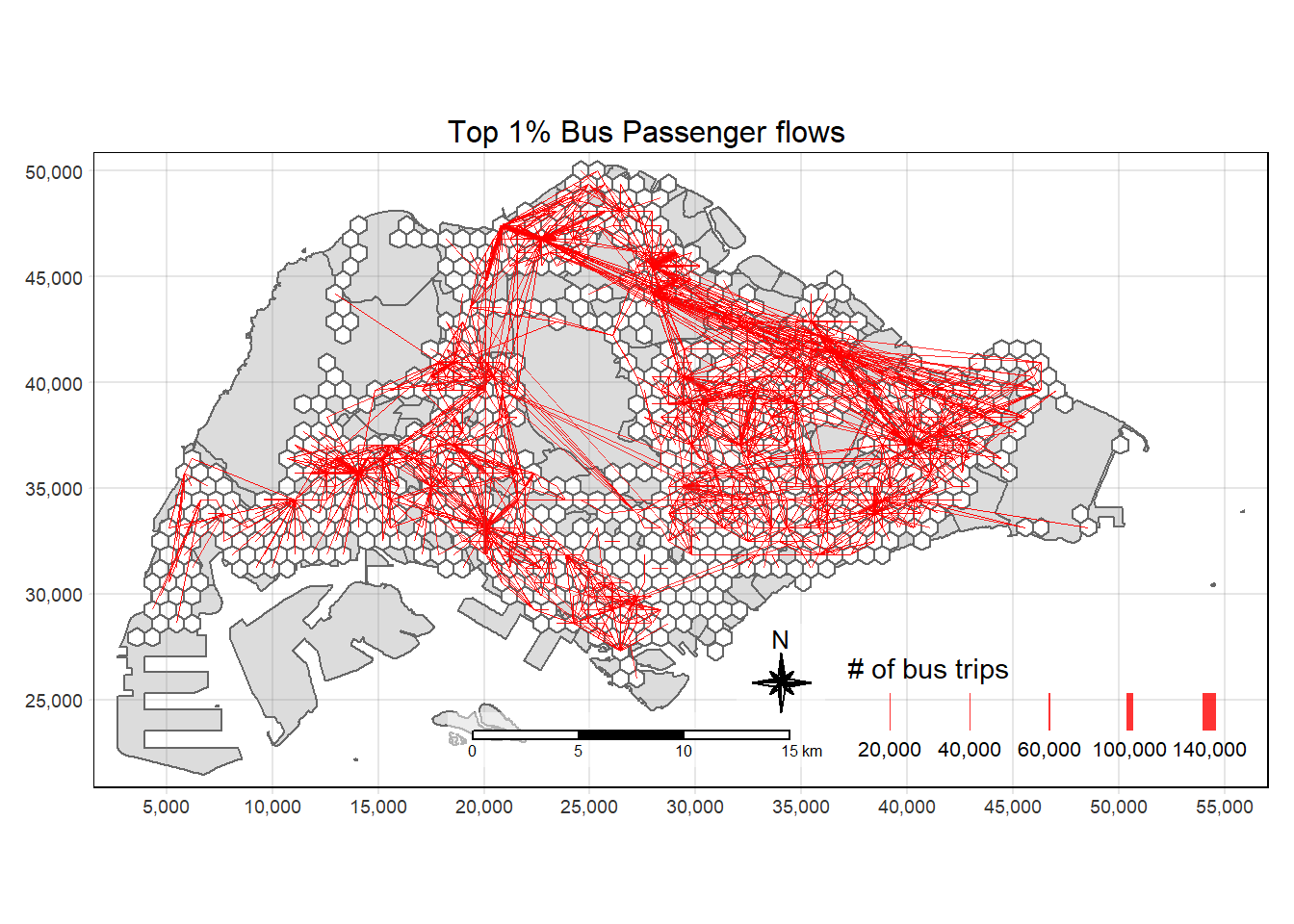
Plotting TRIPS vs DISTANCE
ggplot(SIM_data,
       aes(x = DISTANCE, y = TRIPS)) +
  geom_point() +
  geom_hline(yintercept = 2386, color = "red", linetype = "dashed") +
  annotate("text", x = 20000,
           y = 600, label = "95th percentile",
           hjust = -0.1, color = "red", size = 3) +
  geom_hline(yintercept = 1510, color = "purple", linetype = "dashed") +
  annotate("text", x = 20000,
           y = 1800, label = "99th percentile",
           hjust = -0.1, color = "purple", size = 3) +
  labs(title = "Number of Trips as a Function of Distance",
       x = "Distance (m)",
       y = "Number of Trips")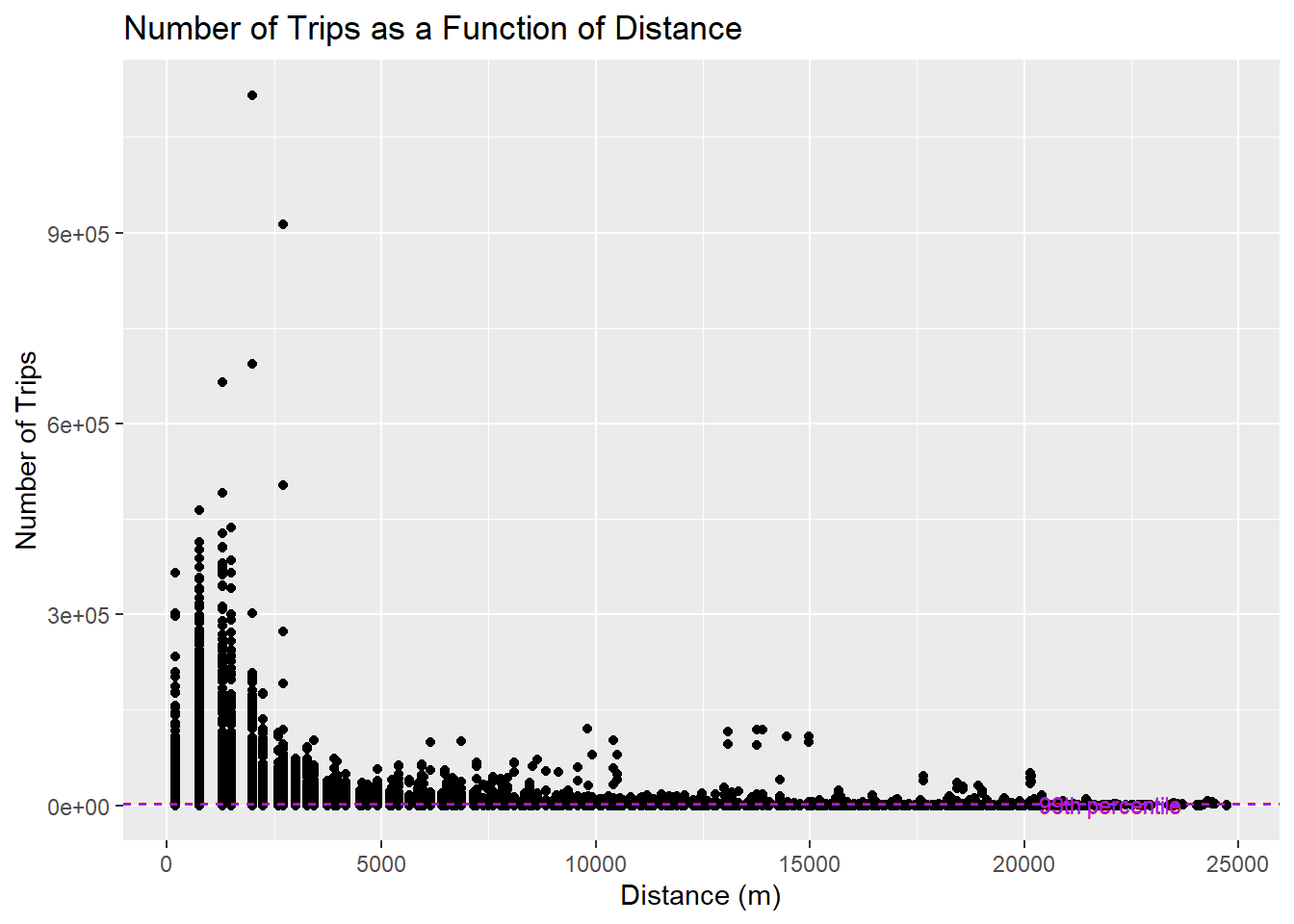
ggplot(SIM_data,
       aes(x = log(DISTANCE), y = log(TRIPS))) +
  geom_point() +
  geom_smooth(method = lm)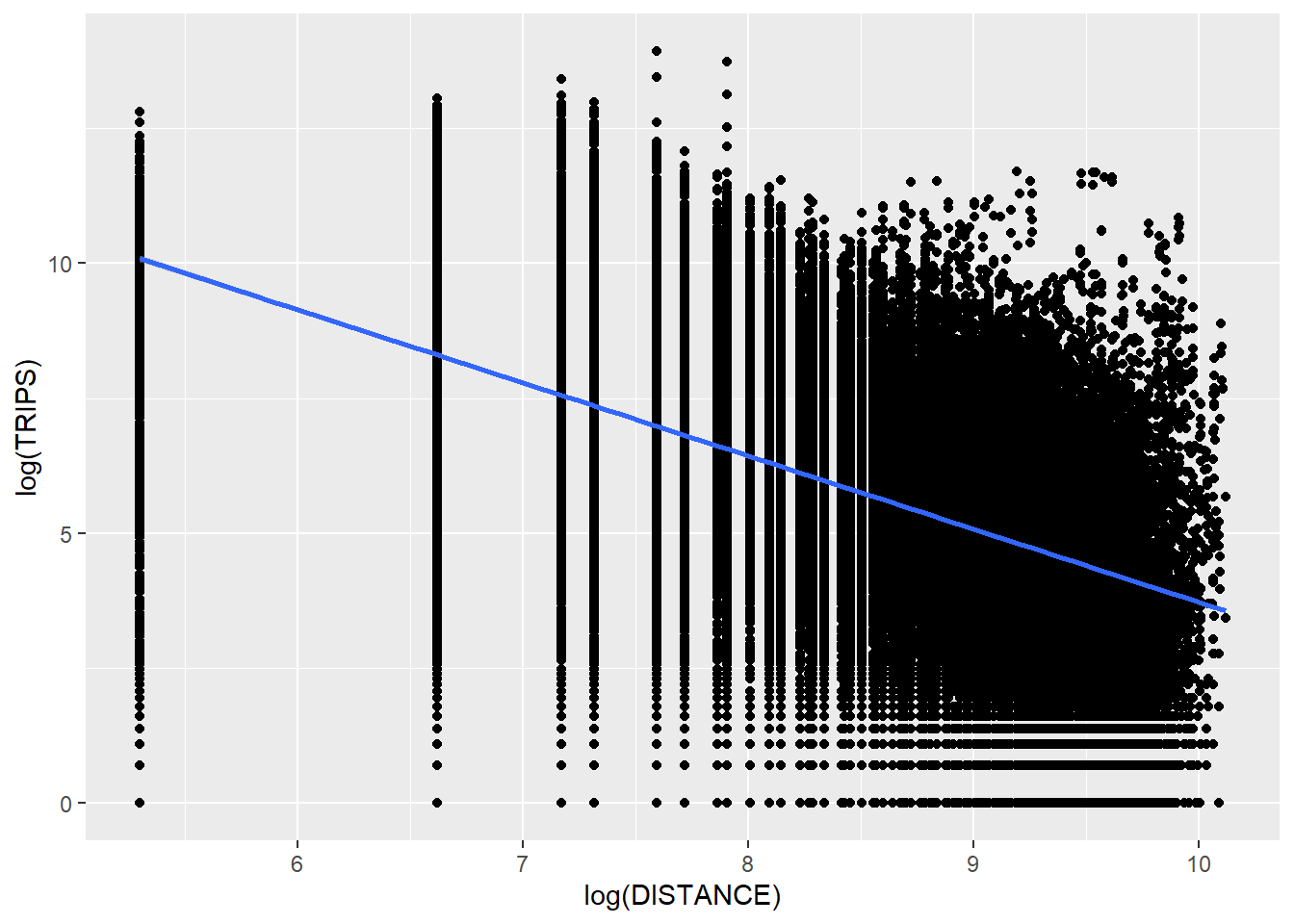
Visualising propulsive forces
::: {callout-tip collapse=“true”} ### Creating a helper function
plot_propulsive <- function(var_name, title_comp, day_type = NULL, hour = NULL, pa=NULL) {
  flowlines_filtered <- flowlines_no_intra

  if (!is.null(day_type)) {
    flowlines_filtered <- flowlines_filtered %>% filter(DAY_TYPE == day_type)
  }

  if (!is.null(hour)) {
    flowlines_filtered <- flowlines_filtered %>% filter(TIME_PER_HOUR == hour)
  }

  if (!is.null(pa)) {
    flowlines_filtered <- flowlines_filtered %>% filter(ORIGIN_SUBZONE == pa)
  }

  tm_shape(mpsz3414) +
  tm_polygons("lightgrey", title = "Singapore Boundary") +

  # Adding this layer underneath propulsiveness as we removed 0s. from the map
  # so it won't skew the legend
  tm_shape(hex_grids) +
  tm_polygons(col = "white") +

  tm_shape(propulsiveness %>% filter(if_any(var_name, ~. >= 1))) +
  tm_polygons(var_name, palette = "Blues", style = "quantile") +

  tm_shape(flowlines_no_intra %>% filter(TRIPS > 2385)) +
  tm_lines(lwd = "TRIPS",
           style = "quantile",
           col = "red",
           scale = c(0.1, 1, 3, 5, 7, 10),
           title.lwd = "# of bus trips",
           n = 6,
           alpha = 0.5) +

  tm_layout(main.title = paste("Top 1% Bus Passenger Flows and", title_comp),
            main.title.position = "center",
            main.title.size = 1.0,
            legend.height = 0.35,
            legend.width = 0.35,
            frame = TRUE) +

  tm_scale_bar(bg.color = "white", bg.alpha = 0.7, position = c("right", "top")) +
  tm_compass(type="8star", size = 2, bg.color = "white",
             bg.alpha = 0.5, position = c("right", "top")) +
  tm_grid(alpha = 0.2) +
  tm_credits("*Passenger data",
             bg.color = "white", bg.alpha = 0.7,
             position = c("left", "bottom"))
}
:::
Looking at transfers from Buses.
plot_propulsive("BUS_ALIGHT_COUNT", "Potential Transfers from Bus")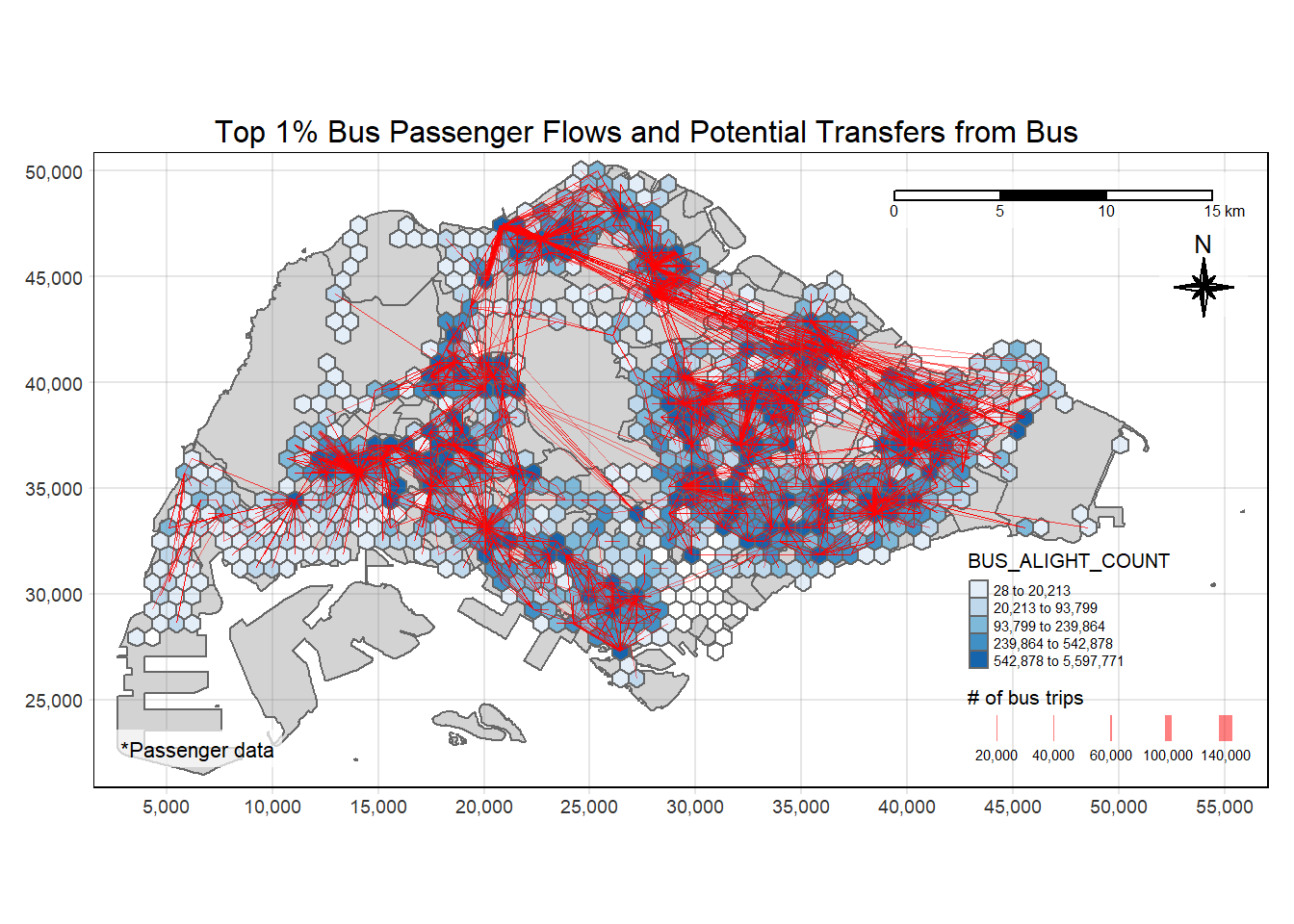
Visualising attractive forces
::: {callout-tip collapse=“true”} ### Creating a helper function
plot_attractive <- function(var_name, title_comp, day_type = NULL, hour = NULL, pa = NULL) {
  flowlines_filtered <- flowlines_no_intra

  if (!is.null(day_type)) {
    flowlines_filtered <- flowlines_filtered %>% filter(DAY_TYPE == day_type)
  }

  if (!is.null(hour)) {
    flowlines_filtered <- flowlines_filtered %>% filter(TIME_PER_HOUR == hour)
  }

  if (!is.null(pa)) {
    flowlines_filtered <- flowlines_filtered %>% filter(DESTINATION_SUBZONE == pa)
  }

  tm_shape(mpsz3414) +
  tm_polygons("green", title = "Singapore Boundary") +

  # Adding this layer underneath attractiveness as we removed 0s. from the map
  # so it won't skew the legend
  tm_shape(hex_grids) +
  tm_polygons(col = "white") +

  tm_shape(attractiveness %>% filter(if_any({{var_name}}, ~. >= 1))) +
  tm_polygons({{var_name}}, palette = "Purples", style = "quantile") +

  tm_shape(flowlines_filtered %>% filter(TRIPS > 2385)) +
  tm_lines(lwd = "TRIPS",
           style = "quantile",
           col = "red",
           scale = c(0.1, 1, 3, 5, 7, 10),
           title.lwd = "# of bus trips",
           n = 6,
           alpha = 0.5) +

  tm_layout(main.title = paste("Top 1% Bus Passenger Flows and", {{title_comp}}),
            main.title.position = "center",
            main.title.size = 1.0,
            legend.height = 0.35,
            legend.width = 0.35,
            frame = TRUE) +

  tm_scale_bar(bg.color = "white", bg.alpha = 0.7, position = c("right", "top")) +
  tm_compass(type="8star", size = 2, bg.color = "white",
             bg.alpha = 0.5, position = c("right", "top")) +
  tm_grid(alpha = 0.2) +
  tm_credits("*Passenger data",
             bg.color = "white", bg.alpha = 0.7,
             position = c("left", "bottom"))
}
:::
plot_attractive("BUS_STOP_COUNT", "Number of Bus Stops")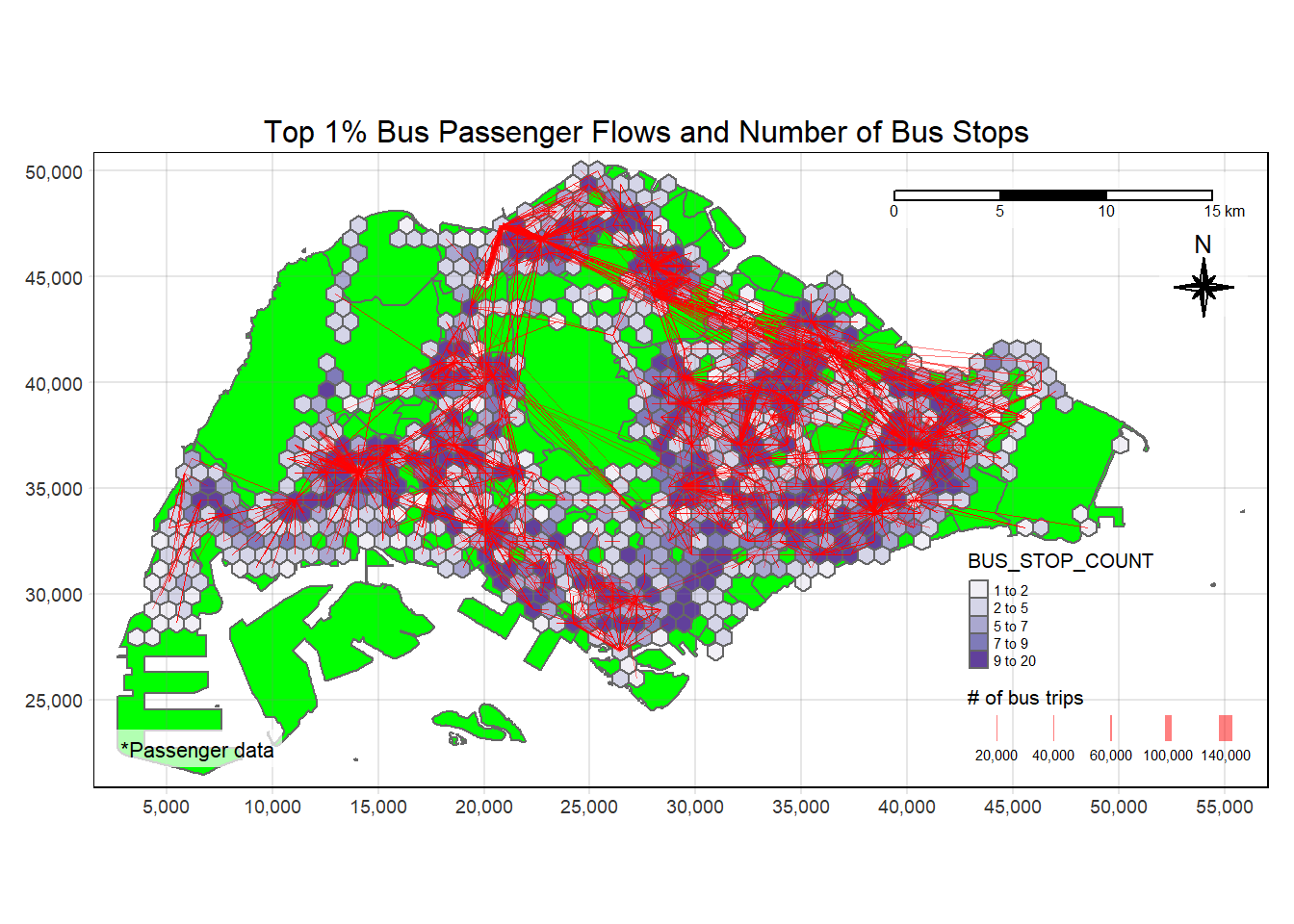
plot_attractive("HDB_COUNT", "Number of HDB Blocks")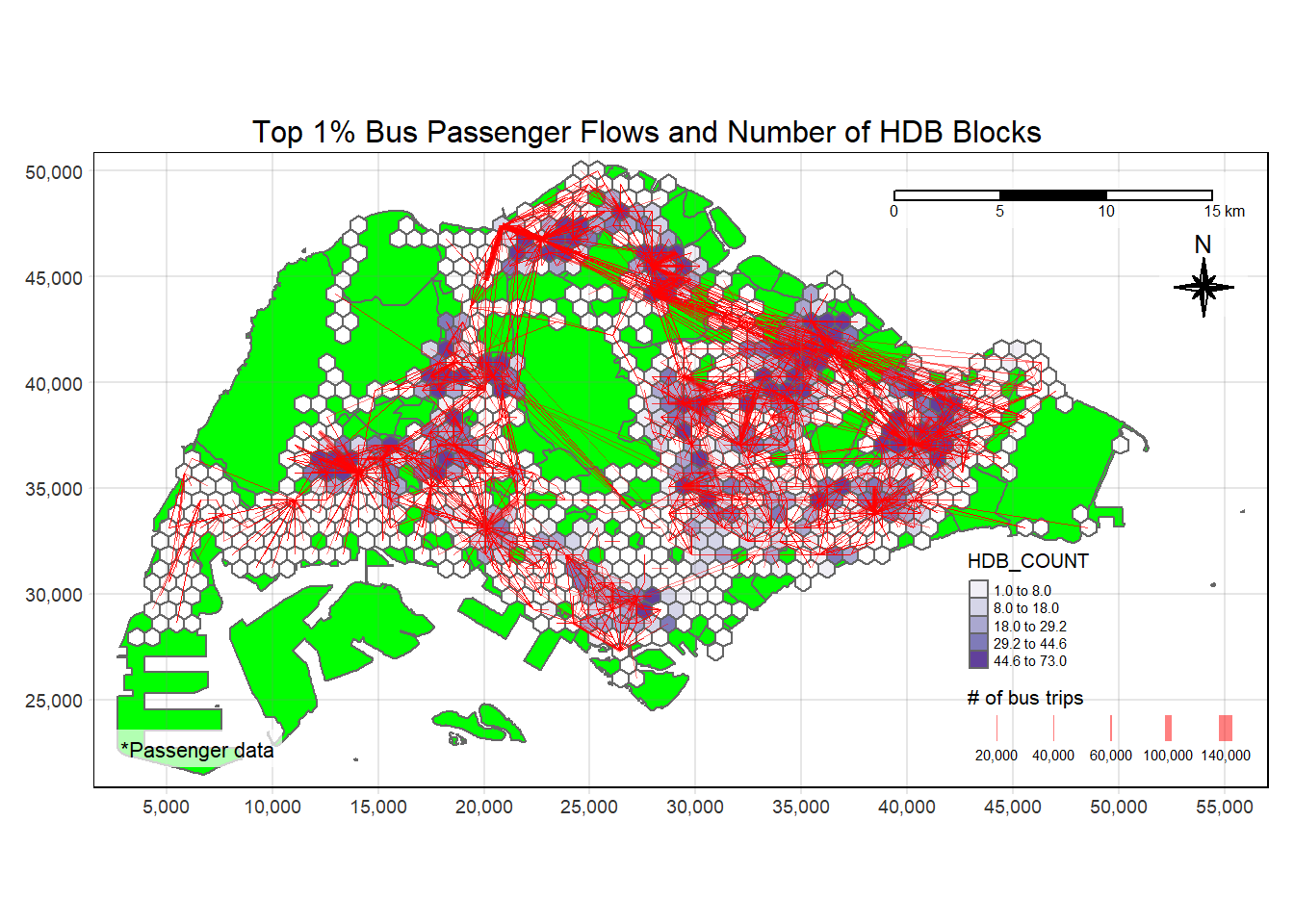
plot_attractive("BIZ_COUNT", "Number of Business Locations", day_type = "WEEKENDS/HOLIDAY")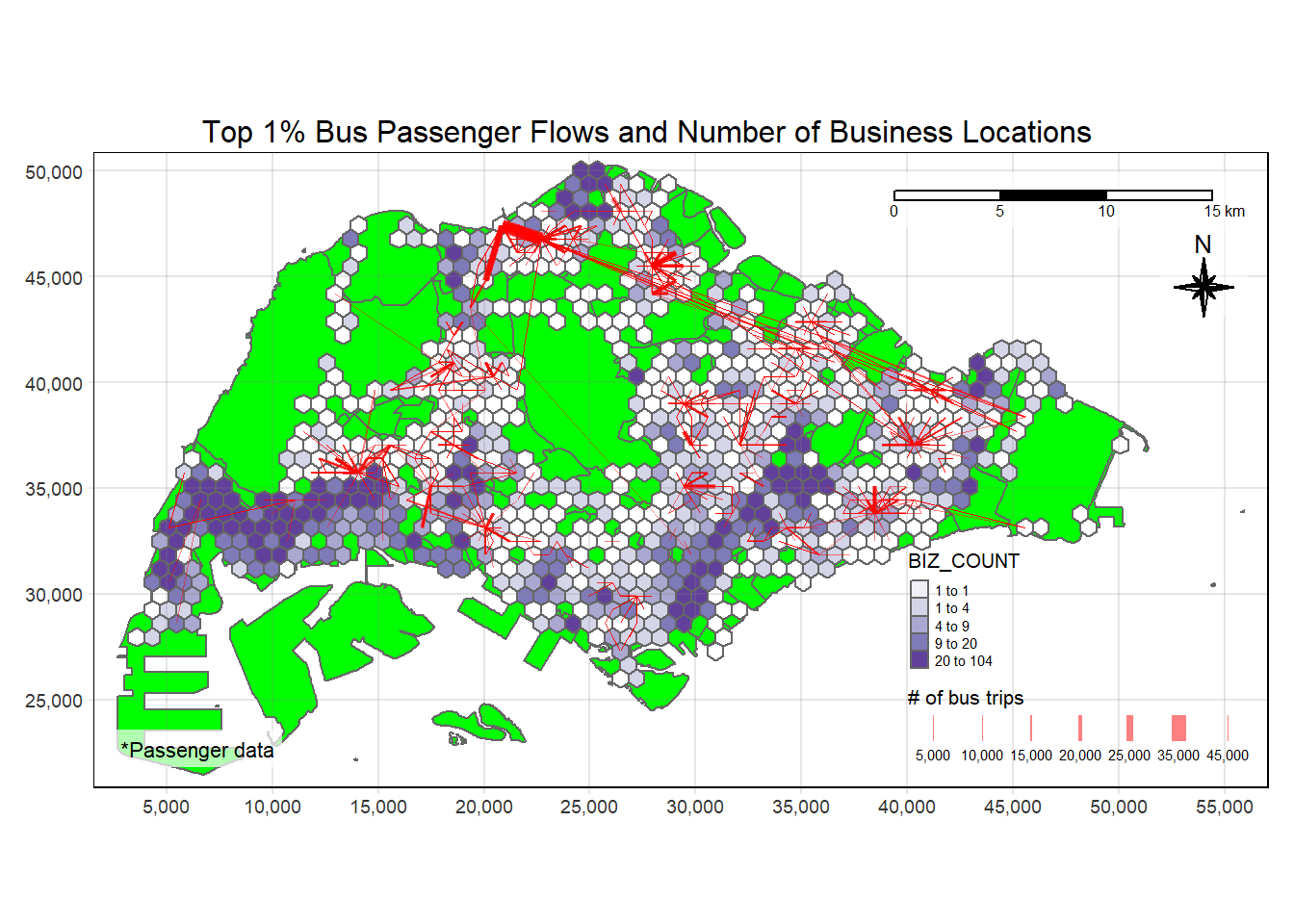
plot_attractive("ENTERTN_COUNT", "Number of Entertainment \nLocations at 5pm on Weekdays", day_type = "WEEKDAY", hour=17)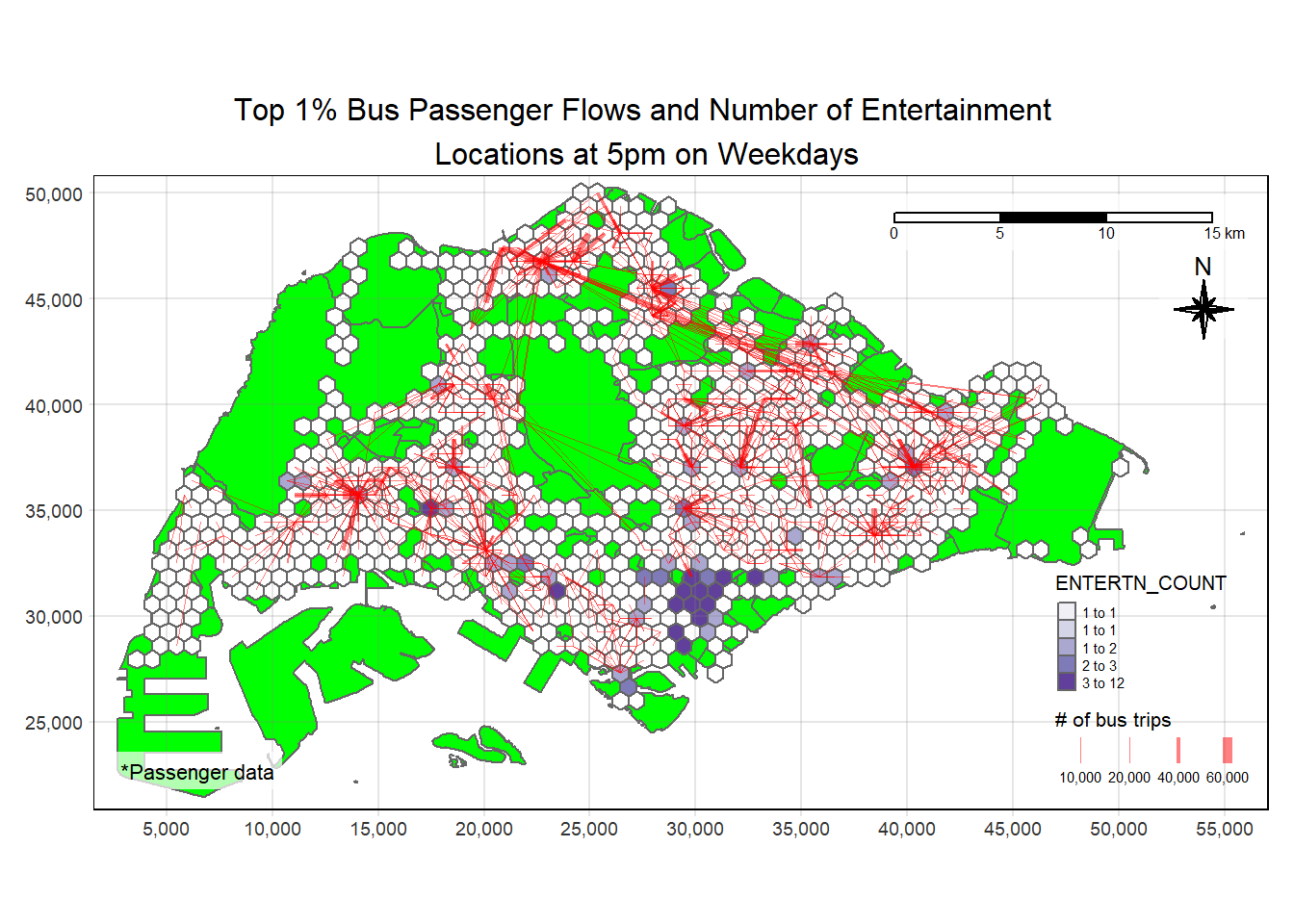
plot_attractive("FOOD_BEV_COUNT", "Number of F&B Locations", pa = "BEDOK")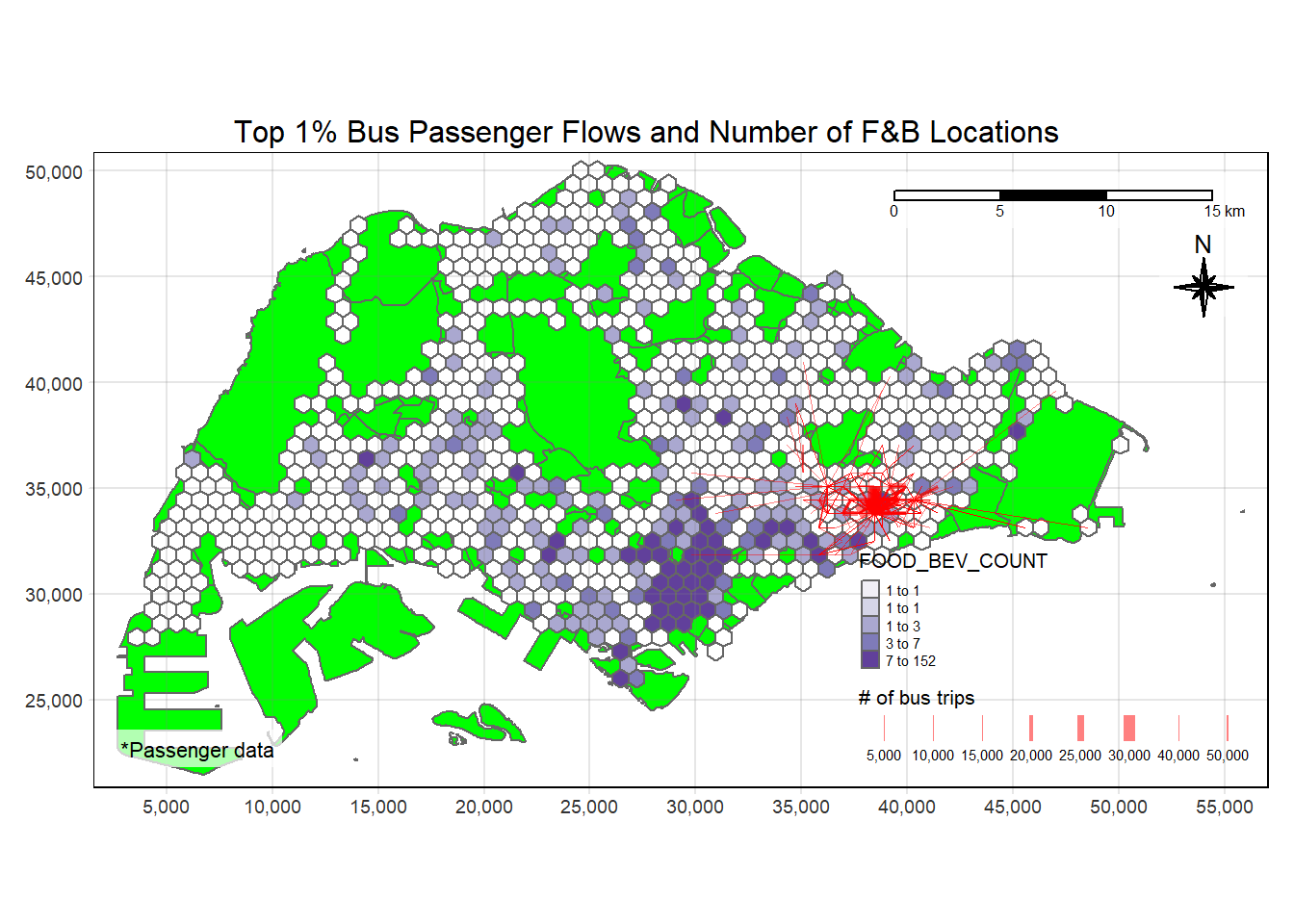
plot_attractive("LEISURE_COUNT", "Number of Leisure \n& Recreation Spots attracting flows to Bedok and Paya Lebar", pa = c("BEDOK", "PAYA LEBAR"))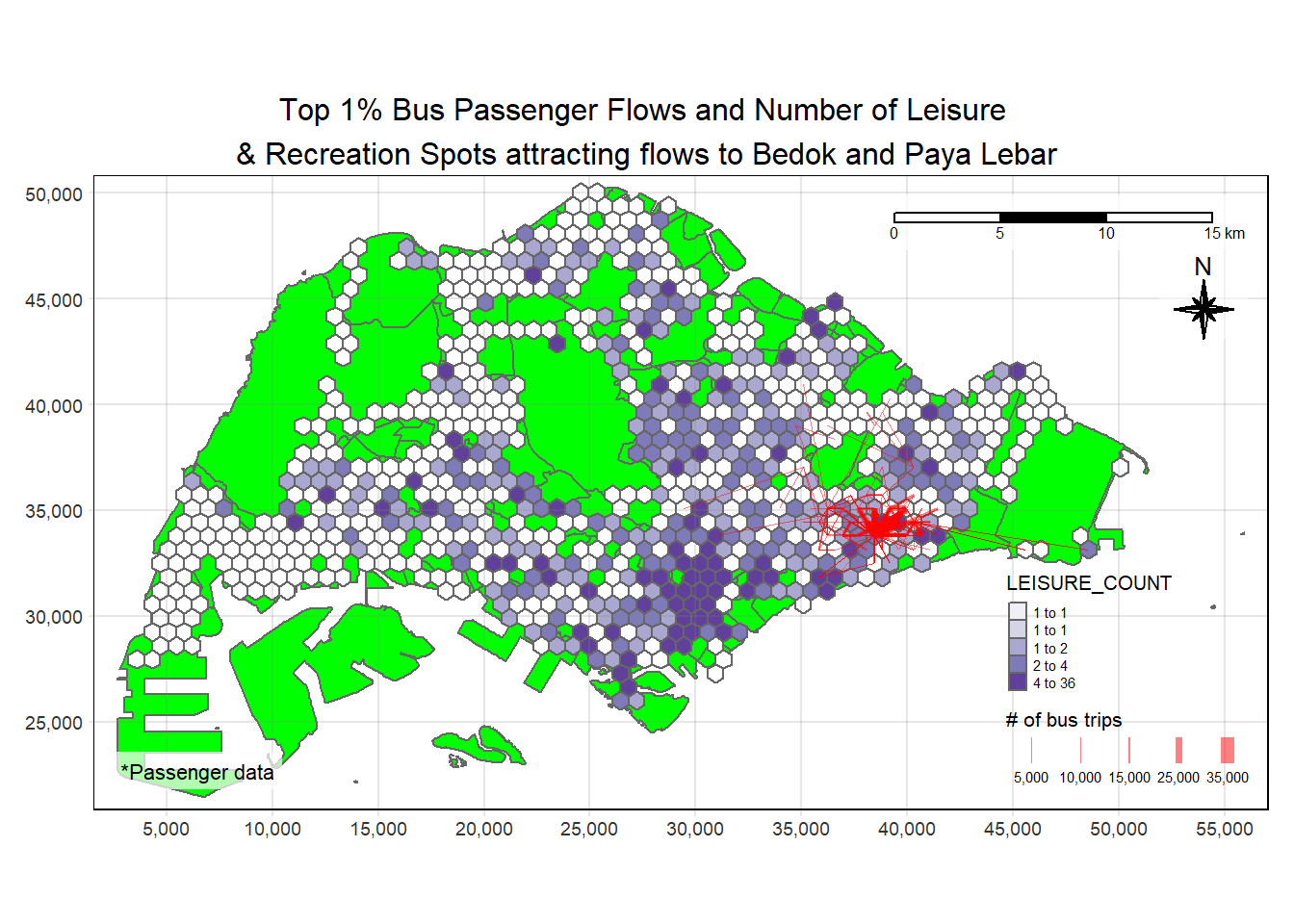
plot_attractive("RETAIL_COUNT", "Number of Retail Locations at 1pm", hour = 13)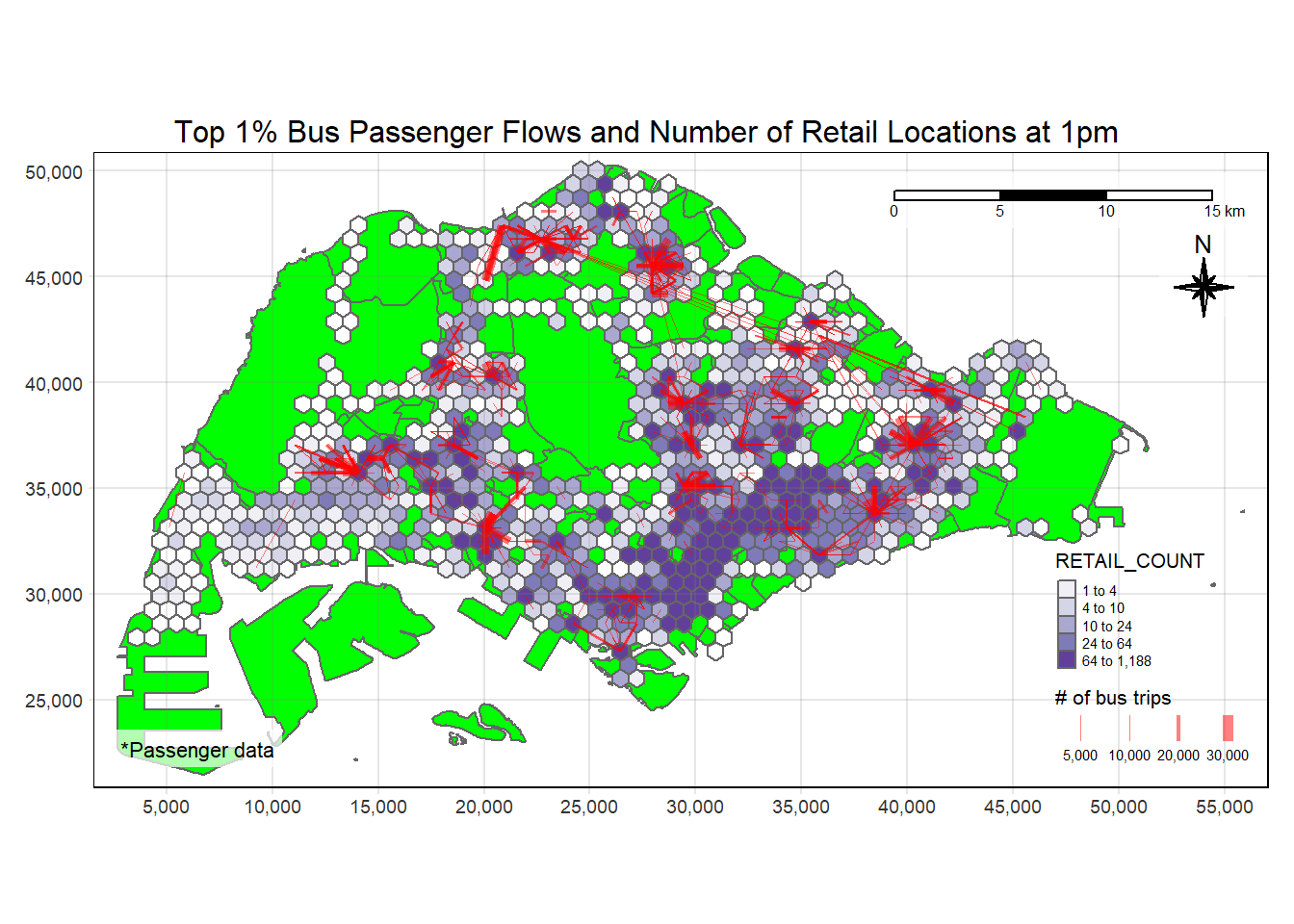
plot_attractive("FIN_COUNT", "Number of Financial Service Locations")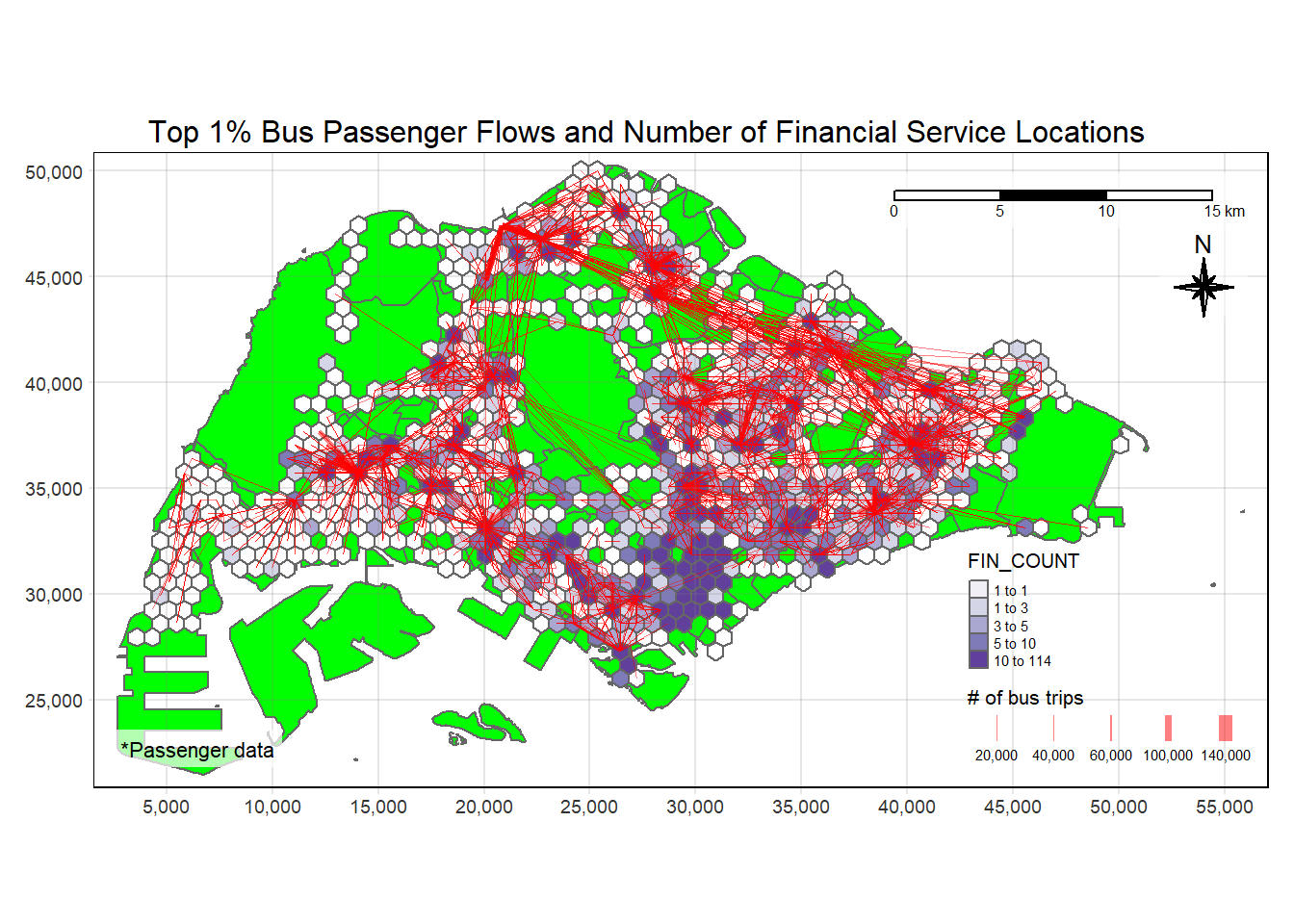
plot_attractive("HC_COUNT", "Number of Public Healthcare Spots")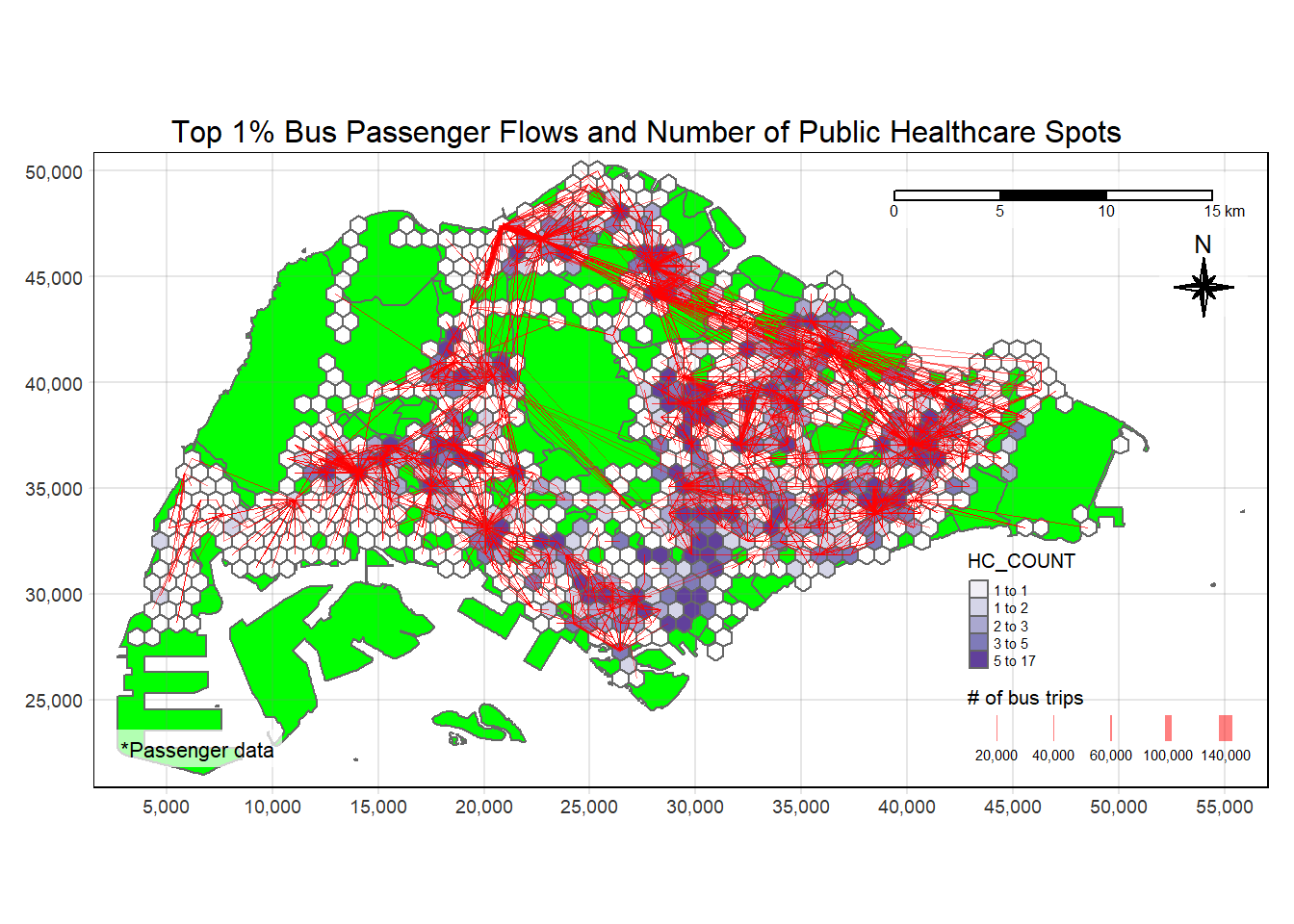
plot_attractive("SCH_COUNT", "Number of School Locations")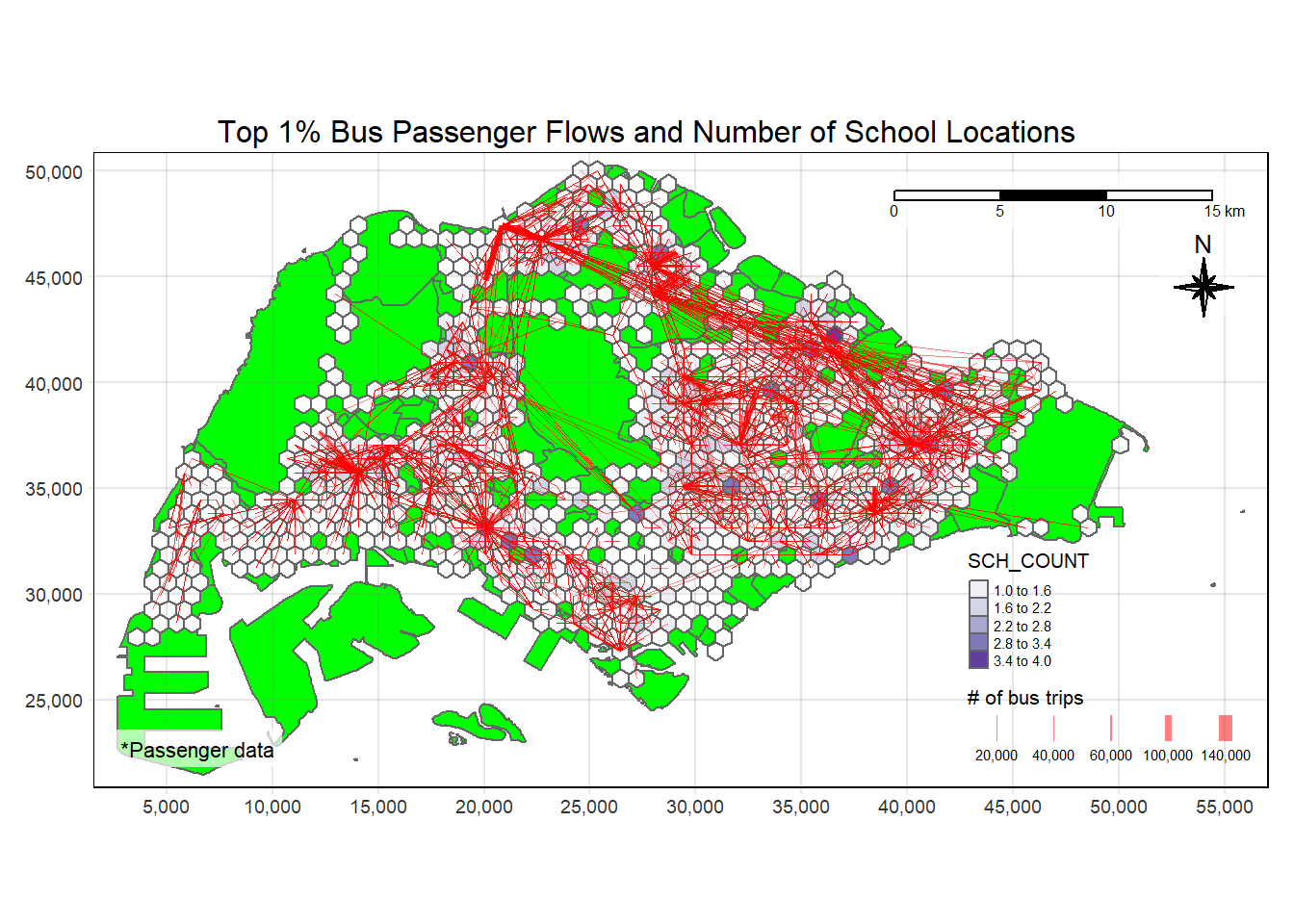
7.1 Prototype Potential
The user inputs will include:
Flow direction with the choices of
Overall,Outgoing,IncomingA viewing level drop-down bar with choices of
Overall,PLN_AREA. IfPLN_AREAis selected, there will be a further drp-down feature for the user to select the interested planning areas of the Origins and Destinations.Day type with the choices of
Overall,WEEKDAY,WEEKENDS/HOLIDAYSTime hour choice in a sliding bar style, ranging from 0 to 23.
A sliding bar to control the number of trips shown based on the user inputs
8.0 Spatial Econometric Interaction Modelling
Remove the intra-zonal zones pairs from SIM_data.
SIM_data_no_intra <- SIM_data %>% filter(ORIG_HEX_ID != DEST_HEX_ID)To calibrate SEIM using spflow package, three data sets are required:
Spatial Weights
Distance Matrix
Explanatory Variables
Prepare Spatial Weights
hex_grid <- st_make_grid(mpsz3414, cellsize = c(750, 750), what = "polygons", square = FALSE) %>%
  st_sf() %>%
  # Apply as.factor() since index will be used as the identifier to link to other data sets
  mutate(index = as.factor(row_number()))

# Create border of Singapore's land area
mpsz_border <- mpsz3414 %>% st_union()

# Clip the hexagon grid layer
hex_grid_bounded <- st_intersection(hex_grid, mpsz_border)

# Check if hex grid intersects any polygons using st_intersects
# Returns a list of intersecting hexagons
intersection_list = hex_grid$index[lengths(st_intersects(hex_grid, hex_grid_bounded)) > 0]

# Filter for the intersecting hexagons
hex_grids = hex_grid %>%
  filter(index %in% intersection_list)


hex_grids$BUS_COUNT <- lengths(st_intersects(hex_grids, BusStop))
hex_grids$ENTERTN_COUNT <- lengths(st_intersects(hex_grids, entertn))
hex_grids$FOOD_BEV_COUNT <- lengths(st_intersects(hex_grids, food_bev))
hex_grids$LEISURE_COUNT <- lengths(st_intersects(hex_grids, leis_rec))
hex_grids$RETAIL_COUNT <- lengths(st_intersects(hex_grids, retail))
hex_grids$BIZ_COUNT <- lengths(st_intersects(hex_grids, biz))
hex_grids$FIN_COUNT <- lengths(st_intersects(hex_grids, fin))
hex_grids$HDB_COUNT <- lengths(st_intersects(hex_grids, hdb_residential2))
hex_grids$HC_COUNT <- lengths(st_intersects(hex_grids, hc))
hex_grids$SCHOOL_COUNT <- lengths(st_intersects(hex_grids, schools))


tm_shape(hex_grids) +
  tm_fill(col = "BUS_COUNT",
          palette = "Blues",
          style = "cont",
          title = "Bus Stop Density") +
  tm_borders(col="grey")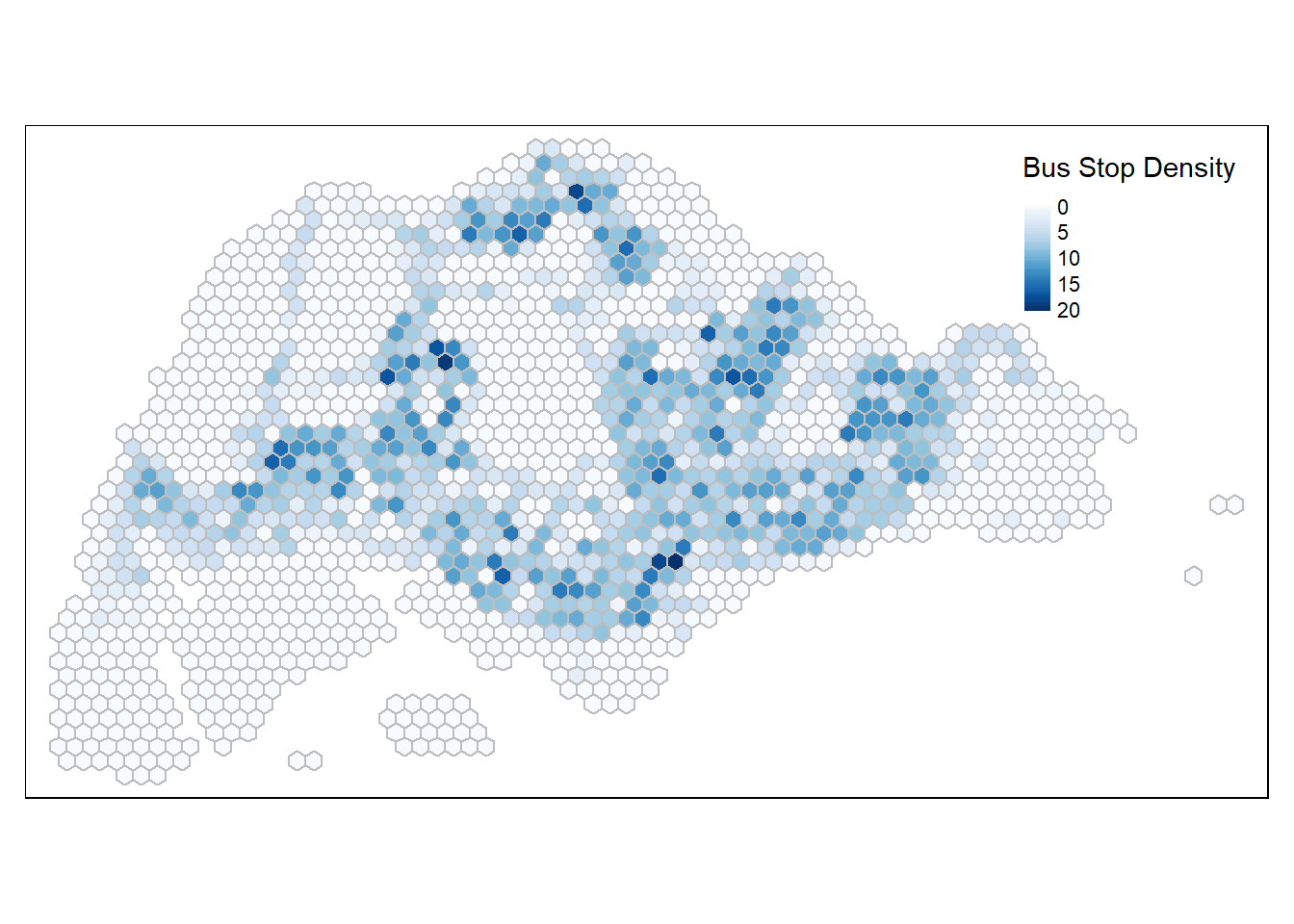
coords <- hex_grids %>%
  filter("BUS_COUNT" > 0) %>%
  select(geometry) %>%
  st_centroid()

k1 <- knn2nb(knearneigh(coords))
k1dists <- unlist(nbdists(k1, coords, longlat = FALSE))

# Print summary report
summary(k1dists)
Min. 1st Qu. Median Mean 3rd Qu. Max.
750.0 750.0 750.0 751.6 750.0 3436.9 The largest first nearest neighbour distance is 2461.2.
centroids <- suppressWarnings({
    st_point_on_surface(st_geometry(hex_grids))})

hexgrid_nb <- list(
  "by_contiguity" = poly2nb(hex_grids),
  "by_distance" = dnearneigh(centroids,
                             d1 = 0, d2 = 3437),
  "by_knn" = knn2nb(knearneigh(centroids, 6))
)

hexgrid_nb
$by_contiguity
Neighbour list object:
Number of regions: 1673
Number of nonzero links: 9478
Percentage nonzero weights: 0.3386295
Average number of links: 5.665272
1 region with no links:
1671
5 disjoint connected subgraphs
$by_distance
Neighbour list object:
Number of regions: 1673
Number of nonzero links: 119676
Percentage nonzero weights: 4.275778
Average number of links: 71.53377
2 disjoint connected subgraphs
$by_knn
Neighbour list object:
Number of regions: 1673
Number of nonzero links: 10038
Percentage nonzero weights: 0.3586372
Average number of links: 6
2 disjoint connected subgraphs
Non-symmetric neighbours listPreparing Flow Data
flowlines$DISTANCE <- dist_tbl$DISTANCE[match(paste(flowlines$ORIG_HEX_ID, flowlines$DEST_HEX_ID), paste(dist_tbl$ORIG_HEX_ID, dist_tbl$DEST_HEX_ID))]

flow_data <- flowlines %>%
  select(ORIG_HEX_ID, DEST_HEX_ID, TRIPS, DISTANCE) %>%
  group_by(ORIG_HEX_ID, DEST_HEX_ID, DISTANCE) %>%
  summarise(TRIPS = sum(TRIPS)) %>%
  ungroup()

write_rds(flow_data, "data/rds/flow_data_3b.rds")
flow_data <- read_rds("data/rds/flow_data_3b.rds")Preparing Explanatory Variables
explanatory <- hex_grids %>%
  st_drop_geometry()

write_rds(explanatory, "data/rds/explanatory.rds")

explanatory <- read_rds("data/rds/explanatory.rds")
Creating spflow_network-class objects
hex_net <- spflow_network(
  id_net = "sg",  # assign an id name, can give it any input
  node_neighborhood = nb2mat(hexgrid_nb$by_distance),
  node_data = explanatory,
  node_key_column = "index"
)

hex_net
Spatial network nodes with id: sg
--------------------------------------------------
Number of nodes: 1673
Average number of links per node: 71.534
Density of the neighborhood matrix: 4.28% (non-zero connections)
Data on nodes:
index BUS_COUNT ENTERTN_COUNT FOOD_BEV_COUNT LEISURE_COUNT RETAIL_COUNT
1 25 0 0 0 0 0
2 26 0 0 0 0 0
3 27 0 0 0 0 0
4 28 0 0 0 0 0
5 29 0 0 0 0 0
6 47 0 0 0 0 0
--- --- --- --- --- --- ---
1668 2957 0 0 0 0 0
1669 3003 0 0 0 0 0
1670 3026 0 0 0 0 0
1671 3205 0 0 0 0 0
1672 3276 0 0 0 0 0
1673 3322 0 0 0 0 0
BIZ_COUNT FIN_COUNT HDB_COUNT HC_COUNT SCHOOL_COUNT
1 0 0 0 0 0
2 0 0 0 0 0
3 0 0 0 0 0
4 0 0 0 0 0
5 0 0 0 0 0
6 0 0 0 0 0
--- --- --- --- --- ---
1668 0 0 0 0 0
1669 0 0 0 0 0
1670 0 0 0 0 0
1671 0 0 0 0 0
1672 0 0 0 0 0
1673 0 0 0 0 0Create spflow_network_pair-class using spflow_network_pair()
hex_net_pairs <- spflow_network_pair(
  id_orig_net = "sg",
  id_dest_net = "sg",
  pair_data = flow_data,
  orig_key_column = "ORIG_HEX_ID",
  dest_key_column = "DEST_HEX_ID"
)

hex_net_pairs
hex_multi_net <- spflow_network_multi(hex_net, hex_net_pairs)
hex_multi_netReferences
M. Chan. Applied Spatial Interaction Models - Case Study of Singapore Public Bus Commuter Flows. https://geospatial2023.netlify.app/take_home_exercise/ex2/take_home_ex2#calibrate-spatial-econometric-interaction-model-usng-maximum-likelihood-estimation
K. J. Paas, 2023. Take Home Exercise 2: A Case Study of Singapore Public Bus Commuter Flows. https://isss624-kjcpaas.netlify.app/take-home_ex2/take-home_ex2
T. S. Kam.